

Quick Summary
Mushroom hats made from amadou are soft, light and breathable, but they absorb and hold sweat rather than wicking it away the way polyester performance fabrics do. The article does not state a measured wicking rate, so there is no verified number for how fast amadou moves moisture.
- Amadou is processed trama from the bracket fungus Fomes fomentarius, with a velvety, suede-like feel.
- Its dense fungal structure tends to absorb and hold moisture rather than transport it.
- Breathable does not mean moisture-wicking, since air flow and liquid transport are separate properties.
- A thin moisture-wicking liner under the hat can handle sweat transport while the amadou shell provides shade.
- Test two hats side by side by weighing them dry, spraying a measured dose of water, and timing their dry-down.
Table of Contents
- What is a mushroom hat and what is it made from?
- What is a sweat-wicking hat, and what makes a material wick?
- How amadou Fomes Fomentarius material handles moisture
- Can mushroom hats get wet, and how do they recover?
- Breathable hats for hot weather: choosing the right style
- How to test a hat's moisture-wicking claims yourself
- Choosing your next hat: docker cap or flat cap for sweat and sun
- Frequently Asked Questions
Are mushroom hats moisture-wicking? 5 things to know
Last Updated: November 1, 2026
What is a mushroom hat and what is it made from?
Mushroom hats are headwear made from the fibrous flesh of certain fungi, most often Fomes fomentarius, a bracket fungus that grows on beech trees. Amadou makes its hats from this material, sometimes called amadou or "mushroom leather" Mushroom hats are a niche category, and most shoppers are asking whether they keep sweat away from the skin.
The short answer is that the material is soft, light, and breathable, but whether it wicks moisture the way technical fabrics do is a separate question. Amadou's Big Rim Hat is made from this material. Here is how the material works and what to expect.
- Material: Processed trama (the inner fibers) of Fomes fomentarius
- Feel: Velvety, similar to suede, and light in weight
- Care: nature-based and chemical-free
What is a sweat-wicking hat, and what makes a material wick?
A sweat-wicking hat is one that moves moisture away from your skin so it can evaporate. Wicking depends on capillary action, which pulls liquid along fibers, and on how quickly the fabric lets that moisture evaporate. Synthetic performance fabrics like polyester are engineered for this, which is why they are common in running and outdoor gear.
Many people assume that any breathable material wicks sweat. That is not always true. Breathability (air moving through the fabric) and wicking (moving liquid sweat outward) are related but separate properties. A fabric can feel airy and still hold moisture against your head.
Key factors that affect wicking include:
- Fiber type: Hydrophobic synthetics often move water faster than natural fibers
- Fabric density: Tighter weaves can slow evaporation
- Lining: A moisture-moving liner can help sweat leave the skin
How amadou Fomes Fomentarius material handles moisture
Amadou is not a woven textile. It is the hand stretched trama of Fomes fomentarius, a bracket fungus whose inner flesh is made of densely interlocked hyphae, microscopic fungal threads that form a felt-like, spongy structure. That structure is why the material behaves differently from both cotton and polyester, and it is the key to answering whether a mushroom hat actually wicks.
Property |
Amadou (fungal trama) |
Polyester performance knit |
|---|---|---|
Primary behavior |
Absorbs and evaporates |
Transports and evaporates |
Feel against skin when dry |
Velvety, suede-like |
Smooth, often cool |
Behavior at high sweat load |
Can saturate but release fast |
Spreads and releases faster |
Breathability |
Good (porous, no tight weave) |
Good to excellent (engineered mesh) |
Aging |
Develops patina, may stiffen if soaked |
Dimensionally stable |
Breathability and weight compared with felt
The brand describes its hats as a softer, more breathable alternative to heavy felt.
Light weight helps in warm weather, but it does not tell you how a hat handles sweat. Compare the weight and ventilation of any hat you consider, not just the material name.
Can mushroom hats get wet, and how do they recover?
The brand says the hats develop character as they age. That aging is a feature for many buyers, but it also means the look changes over time.
Breathable hats for hot weather: choosing the right style
If your main goal is staying cool, style matters as much as material. A wide brim shades your face and neck, while a lower-profile cap fits closer to the head and lets less heat collect. Think about where you will wear the hat and for how long.
Amadou offers a style suited to hot days:
- Big Rim Hat (heritage amadou): Wide brim for sun coverage and a lightweight feel
Pick the brim size based on your sun exposure. A wider brim blocks more sun, but it can feel warmer if the crown is tight. The right choice depends on whether you need shade or simply want a comfortable, breathable hat.
How to test a hat's moisture-wicking claims yourself
Most mushroom-hat content stops at "it feels breathable." You can go further with a structured at-home comparison that mirrors, in a rough way, what a lab would measure. The goal is not a certified rating, it is a fair side-by-side between two hats so you can see which one actually moves sweat.
Hiker wiping sweat from their forehead while wearing a light tan brimmed hat in a sunlit forest clearing
What a real wicking test measures (and why it matters):
- Vertical wicking rate: How fast a fabric pulls liquid upward along its fibers, usually reported in millimeters per a set time. Faster means sweat spreads and evaporates sooner.
- Absorption capacity: How much liquid the material holds per unit weight before it feels saturated.
- Drying time: How long the material takes to return to its dry weight under controlled airflow and temperature.
- Air permeability: How much air passes through the fabric, which governs heat release independent of wicking.
You cannot replicate these precisely at home, but you can approximate the ranking between two hats.
A structured home comparison:
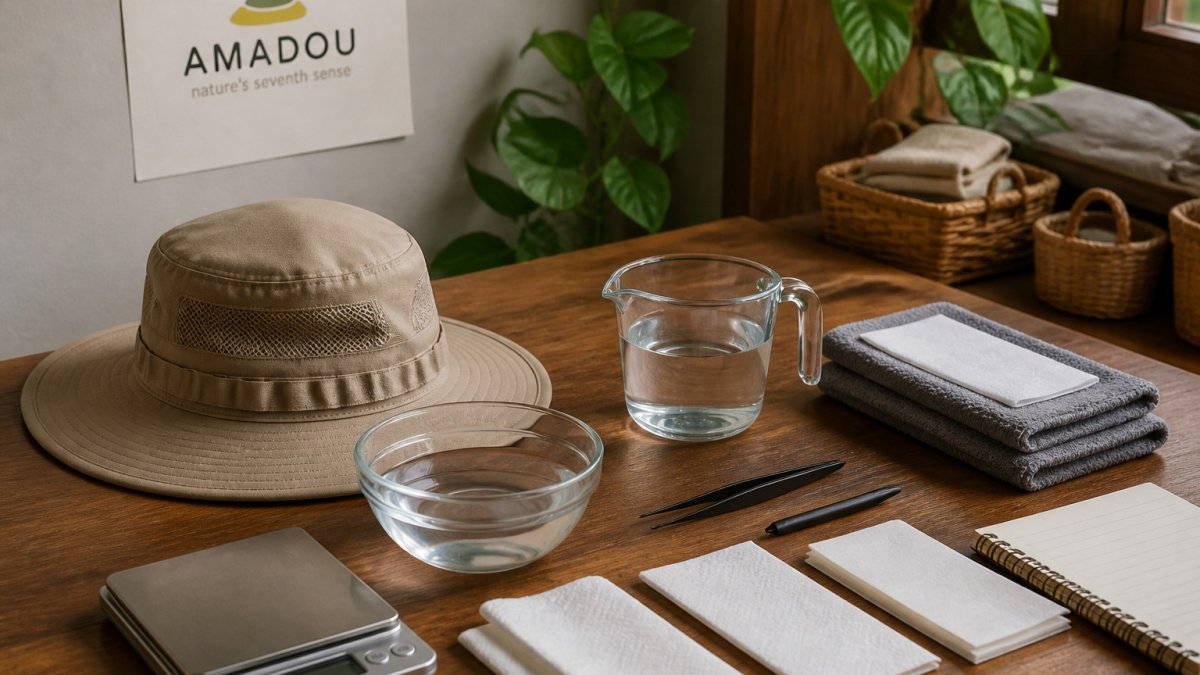
- Weigh both hats dry on a kitchen scale and record the numbers. Use hats of similar size and shape.
- Apply a measured amount of water, a spray bottle with a marked dose (for example, 10 sprays), to the inside sweatband of each hat.
- Time the feel-dry point: check every 2-3 minutes and note when the band stops feeling damp to the touch.
- Weigh again at the feel-dry point to see how much water each hat still holds internally.
- Time full dry-down in the same spot, with the same airflow, and record the total.
- Repeat twice and average, because single trials are noisy.
How to read the results:
- A hat that reaches feel-dry fast but stays heavy is absorbing sweat into its body, comfortable short-term, slower to release.
- A hat that spreads the water over a wider area before drying is showing capillary transport, the signature of a wicking fabric.
- A hat that dries fastest at the same airflow has the best evaporation behavior, which is what you want for sustained activity.
The novelty-shape factor no one talks about: A mushroom hat's oversized cap changes airflow in ways a standard cap does not. A wide, domed crown can trap a pocket of warm, humid air above the head, which slows evaporation even if the fabric itself wicks well. That is why the same amadou material can feel cooler in a lower-profile docker cap than under a broad mushroom brim. When you test, test the shape you will actually wear, and check whether the crown has any venting or open structure that lets that trapped air escape.
The hybrid solution: If you want the mushroom look but need real sweat performance, add a thin moisture-wicking liner or headband under the hat. A polyester or merino liner against the skin does the transport job, and the amadou shell handles shade and breathability. This bridges costume and performance headwear in a way none of the DIY tutorials address.
!A hiker in a sunlit forest clearing wiping sweat from their forehead while wearing a light tan mushroom hat, natural daylight, shallow depth of field
Choosing your next hat: docker cap or flat cap for sweat and sun
Choosing between a docker cap and a flat cap comes down to coverage and fit. A docker cap has a curved brim and a snug, structured crown, which suits workdays and active days. A flat cap sits lower and has a more relaxed, classic look.
For sweat and sun, consider these points:
- Docker cap: Good for activity and a secure fit. Check that the lining does not feel tight.
- Flat cap: Good for casual wear and a classic style. Look for a lighter fabric for warm days.
Amadou's Amadou docker cap is priced at $199.00 and features an adjustable fit with a linen lining. The Amadou flat cap is priced at $215.00 and is made from amadou and linen. Both are listed as lightweight and breathable, so the choice depends on the fit and look you prefer.


If you mainly want shade, the wide-brimmed styles above may suit you better. Whichever you choose, test the fit in person when you can, because natural materials can feel slightly different from one hat to the next.
Frequently Asked Questions
Are mushroom hats moisture-wicking?
Mushroom hats are not automatically moisture-wicking. Amadou's own listings describe their hats as lightweight and breathable, but the supplied research contains no independent test results measuring wicking performance. Treat the claim as a feature to verify rather than a guarantee. Check the product listing for specific material details, wear the hat during a warm outdoor activity, and watch whether sweat is absorbed into the fabric or sits on the surface.
Can mushroom hats get wet?
The supplied research does not include care instructions or waterproofing data for Amadou hats. Check Amadou's product care guidance before washing or exposing a hat to rain for extended periods.
What is a sweat-wicking hat?
A sweat-wicking hat uses a fabric that pulls moisture away from the skin and spreads it across the material so it can evaporate. Synthetic performance fabrics often do this through capillary action in tightly woven fibers. Natural materials can also absorb sweat, but how quickly they move and release moisture depends on fiber structure, density and construction. Compare a hat's fabric and lining against your own activity level before buying.
Which is better for sweat and sun, a docker cap or a flat cap?
Both Amadou styles use the same base material, so the choice comes down to fit and coverage. The docker cap is listed at $199.00 and includes an adjustable fit with a linen lining, which suits variable head sizes. The flat cap is listed at $215.00 and is made from amadou and linen, described as lightweight and breathable. For hot-weather outdoor use, prioritize the adjustable fit if you expect to wear the hat for long periods.
