

Table of Contents
- Quick Comparison: Mushroom Leather Hat Styles and Prices
- Benefits of Sustainable Mushroom Leather
- Mycelium Leather Durability: What to Expect Over Time
-
Top Mushroom Leather Hats for Every Style
- Amadou Flat Cap: Structured Elegance
- Amadou Docker Cap: Adjustable Comfort
- Big Rim Hat: Heritage Statement
- Bucket Amadou Hat: Casual Coverage
- Amadou Baseball Cap: Sporty Minimalism
- The Forager Hat: Rugged Utility
- Fedora Amadou Hat: Timeless Sophistication
- Paul Stamets Favorite Mushroom Hat: Expert Endorsed
- Curled Brim Trilby: Vintage Flair
- Wizard Hat: Whimsical Statement
- How to Care for Mushroom Leather Accessories
- Comparing Mushroom Leather to Traditional Animal Leather
- Why Choose Mushroom Leather for Your Next Hat
- Frequently Asked Questions
Last Updated: September 13, 2026
Quick Comparison: Mushroom Leather Hat Styles and Prices
Amadou hand-shapes Fomes fomentarius trama into hats that feel like suede and weigh almost nothing. This guide breaks down ten styles, prices, durability, and care.
Mushroom leather is a biomaterial harvested from fungal tissue rather than animal hide or petroleum-based synthetics. Amadou uses the trama layer of the Fomes fomentarius fungus, a material with centuries of use behind it.
| Style | Price | Best For |
|---|---|---|
| Flat Cap | $215 | Structured tailoring |
| Docker Cap | $199 | Adjustable everyday wear |
| Big Rim Hat | $195 | Heritage statement |
| Bucket Hat | $220 | Casual sun coverage |
| Baseball Cap | $175 | Sporty minimalism |
| Forager Hat | $195 | Rugged outdoor use |
| Fedora | $185 | Timeless formal wear |
| Paul Stamets Hat | $175 | Collector value |
| Curled Brim Trilby | $195 | Vintage flair |
| Wizard Hat | $240 | Whimsical statement |
Benefits of Sustainable Mushroom Leather
Mushroom leather earns its place through weight, breathability, and a lower carbon footprint than animal hide or plastic-based vegan leather. It is naturally moisture-wicking, keeping you cool in the sun and comfortable in a breeze.

The environmental case matters too. The United Nations Environment Programme fashion report has documented how heavily conventional textile production leans on virgin resources, which is why renewable materials like fungal trama attract so much attention. Amadou's hats are 100% plant-based and chemical-free, harvested from wild fungus rather than farmed intensively.
Mycelium Leather Durability: What to Expect Over Time
Mycelium leather durability depends on processing, and amadou has an edge because the fungal trama is dense and fibrous by nature. Unlike lab-grown mycelium sheets tanned, bonded, or backed with a polymer carrier, amadou is not a composite. It is the trama layer itself, the soft, spongy interior of the Fomes fomentarius conk, sliced, softened, and hand-shaped. There is no coating to peel, no plastic backing to delaminate, and no finish to flake off.
What you get is a fiber mat that behaves more like felt than chrome-tanned cowhide. The fibers interlock rather than sit in a solid matrix, so the material flexes without cracking and can be re-formed after compression.
What actually happens over 12+ months of wear
Here is how amadou behaves in regular rotation:
- Months 1-3: The hat feels slightly stiff out of the box and softens noticeably within the first few weeks of wear. The surface nap flattens where your hand contacts the brim.
- Months 4-8: Color deepens unevenly, especially on sun-exposed panels. This is oxidation and handling, not fading, the tone usually moves warmer rather than lighter.
- Months 9-12+: The crown holds its blocked shape if stored properly, and the brim develops a slight memory curve from repeated handling. Fibers at high-contact points (sweatband edge, pinch, brim edge) compact and take on a smoother, suede-like hand.
The hat often looks better at month twelve than at month one, the opposite of cheap synthetic caps, which is why owners describe amadou as a patina material rather than a disposable one.
The failure modes to avoid
Durability is less about the material than about what you do to it. Three things shorten an amadou hat's life:
- Crushing storage. Amadou recovers from compression, but repeated crushing in a packed bag trains the fibers into creases that never fully relax. Store it on a hook, a hat stand, or in a box that preserves the crown.
- Prolonged soaking. Light rain is fine and beads off better than felt. A full soak, then drying against a heat source, is what causes shrinkage and stiffening. Blot and air-dry at room temperature.
- Direct, sustained heat. Radiators, dashboards, and hot car trunks dry the fibers out and make them brittle. This is the single most common cause of premature damage.
How it compares to felt and animal leather on wear
| Material | Weight | Water behavior | Aging pattern |
|---|---|---|---|
| Amadou (fungal trama) | Very light | Sheds light rain; blot if soaked | Softens, darkens, holds shape |
| Wool felt | Heavier | Absorbs, can sag | Mats, loses block over time |
| Chrome-tanned leather | Heaviest | Repels, needs conditioning | Creases, cracks if dried out |
| PU "vegan" leather | Light | Repels until coating fails | Peels and flakes at flex points |
The honest trade-off: amadou is not armor. It resists moisture better than felt and ages more gracefully than coated synthetics, but it is a natural fiber mat, not an engineered composite. Treated as a fiber, it outlasts most competitors; treated as indestructible, it will not.
Top Mushroom Leather Hats for Every Style
Ten styles cover everything from boardroom to trail. Each is hand-shaped in Corund, so no two hats are identical, and the organic variation in color and texture is part of the appeal.
Amadou Flat Cap: Structured Elegance
The Amadou flat cap at $215 is crafted from amadou and linen materials. Amadou sheets are meticulously sewn together, ensuring a perfect fit. Best for tailoring without weight.
Amadou Docker Cap: Adjustable Comfort
At $199, the Amadou docker cap adjusts to any head size and is lined with soft linen. It suits all ages, from outdoorsmen to trendsetters. The drawback: the relaxed shape reads casual, not formal.

Big Rim Hat: Heritage Statement
The Big Rim Hat at $195 is the most dramatic silhouette here, hand-shaped from wild-harvested fungus. It feels like premium suede yet stays 100% plant-based. Best for sun coverage with presence.

Bucket Amadou Hat: Casual Coverage
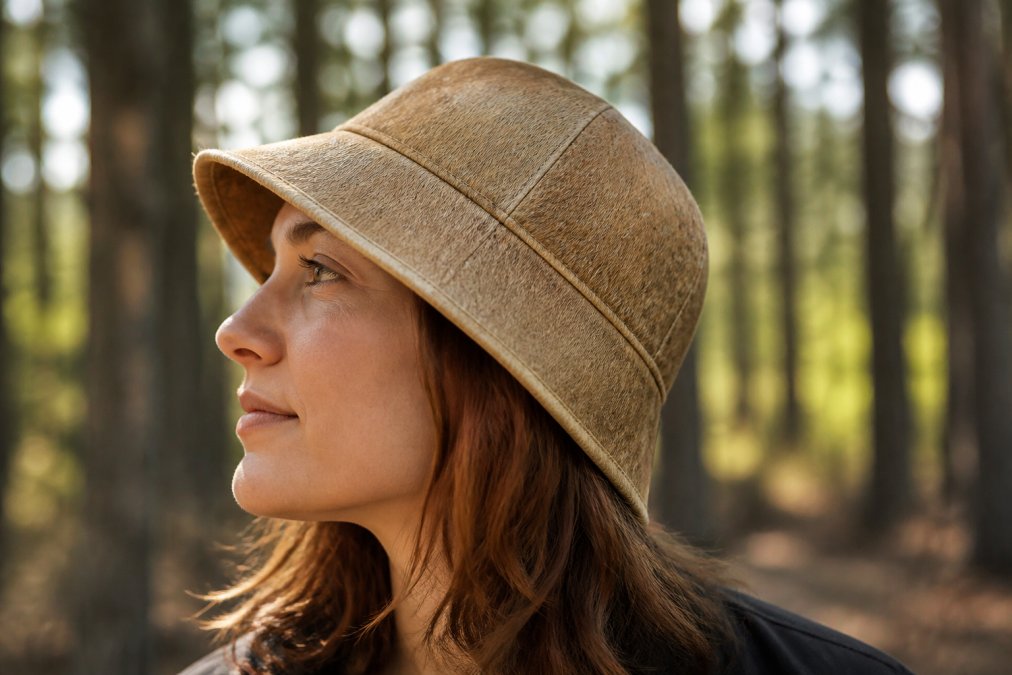
Priced at $220, the Bucket Amadou Hat is a wearable piece of the forest, born from the "Forest Gold" of the Carpathian mountains. Each hat is meticulously hand-shaped from the natural Fomes fomentarius fungus, resulting in a velvety, breathable, and incredibly lightweight accessory that feels like premium suede yet remains 100% plant-based.
Amadou Baseball Cap: Sporty Minimalism
The Amadou baseball cap at $175 is a wearable piece of the forest, born from the "Forest Gold" of the Carpathian mountains. Each hat is meticulously hand-shaped from the natural Fomes fomentarius fungus, resulting in a velvety, breathable, and incredibly lightweight accessory that feels like premium suede yet remains 100% plant-based.
The Forager Hat: Rugged Utility
The Forager Hat costs $195. It is a wearable piece of the forest, born from the "Forest Gold" of the Carpathian mountains. Each hat is meticulously hand-shaped from the natural Fomes fomentarius fungus, resulting in a velvety, breathable, and incredibly lightweight accessory that feels like premium suede yet remains 100% plant-based.
Fedora Amadou Hat: Timeless Sophistication
The Fedora at $185 is a wearable piece of the forest, born from the "Forest Gold" of the Carpathian mountains. Each hat is meticulously hand-shaped from the natural Fomes fomentarius fungus, resulting in a velvety, breathable, and incredibly lightweight accessory that feels like premium suede yet remains 100% plant-based.
Paul Stamets Favorite Mushroom Hat: Expert Endorsed
Priced at $175, the Paul Stamets favorite mushroom hat is a wearable piece of the forest, born from the "Forest Gold" of the Carpathian mountains. Each hat is meticulously hand-shaped from the natural Fomes fomentarius fungus, resulting in a velvety, breathable, and incredibly lightweight accessory that feels like premium suede yet remains 100% plant-based.
Curled Brim Trilby: Vintage Flair
The Curled Brim Trilby at $195 is a wearable piece of the forest, born from the "Forest Gold" of the Carpathian mountains. Each hat is meticulously hand-shaped from the natural Fomes fomentarius fungus, resulting in a velvety, breathable, and incredibly lightweight accessory that feels like premium suede yet remains 100% plant-based.
Wizard Hat: Whimsical Statement
At $240, the Wizard Hat is a wearable piece of the forest, born from the "Forest Gold" of the Carpathian mountains. Each hat is meticulously hand-shaped from the natural Fomes fomentarius fungus, resulting in a velvety, breathable, and incredibly lightweight accessory that feels like premium suede yet remains 100% plant-based.
How to Care for Mushroom Leather Accessories
Caring for mushroom leather accessories takes less effort than most people expect, but "less effort" is not "no method." Most vegan-leather care advice targets PU and PVC, which need plastic-safe cleaners. Amadou is a natural fiber mat, so the protocol is closer to felt and suede. Here is a repeatable routine.
The routine, by frequency
After every wear (30 seconds)
- Brush the surface with a dry, soft-bristled brush or a clean microfiber cloth, working with the nap rather than against it.
- Set the hat on a hook or stand so the crown keeps its block. Never stack it under anything.
Weekly, or after heavy use
- Spot-clean smudges with a dry cloth first. Amadou lifts oils and smudges mechanically, the same property that makes it useful as a lens and screen wipe, so most marks come off without any liquid at all.
- Let the hat air for a few hours between wears so the fibers recover their loft.
Seasonally (twice a year)
- Inspect the sweatband and brim edge, the two highest-contact zones. Compaction there is normal; fraying is not, and it usually signals crushing storage rather than wear.
- Re-block the crown by hand if it has drifted. Amadou holds a shape well but can be gently re-formed while dry.
If something goes wrong
- Water spots: Blot immediately with a dry cloth. Do not rub. Let it air-dry away from heat. Most spots lift on their own as the fibers even out.
- Full soaking: Blot, reshape the crown by hand while damp, and air-dry at room temperature. Never wring, never use a hair dryer, never set it on a radiator.
- Oily marks: A dry cloth with light pressure usually lifts them. If not, a barely damp cloth followed by immediate blotting is the limit, do not saturate the material.
- Odor: Air it out. Amadou is naturally moisture-wicking, so a day of ventilation typically resolves it.
What not to use
- No saddle soap, mink oil, or leather conditioners. These are formulated for animal hide and will darken and clog the fiber mat.
- No machine washing, no detergent soaks, no bleach.
- No waterproofing sprays. Amadou already sheds light rain; a coating defeats the breathability that is the whole point of the material.
- No prolonged direct sun for storage. Sun is fine to wear in; it is not fine to leave the hat sitting in.
Storage that preserves shape
The single highest-impact care habit is storage. A hat box, a hat stand, or even a simple hook keeps the crown blocked and the brim flat. A crushed hat in a backpack is the most common way an amadou piece loses its shape, and the damage is cumulative, not instant.
Comparing Mushroom Leather to Traditional Animal Leather
Mushroom leather differs from animal leather in origin, weight, and breathability, though both develop character over time. Animal hide is heavier, needs tanning chemicals, and traps heat (the EPA). Amadou's fungal trama is lighter, chemical-free, and moisture-wicking.
The tradeoff is uniformity. Because each hat is harvested from the wild and finished by hand, no two are identical, and slight color variation is normal. If you want a perfectly uniform surface, that's the one thing mushroom leather won't give you.
For buyers weighing ethics and comfort together, that variation is usually the selling point, not the flaw.
Why Choose Mushroom Leather for Your Next Hat
Choosing mushroom leather means choosing a material that performs in heat, ages gracefully, and carries a heritage story. Amadou's hats are weightless, breathable, and built to develop a patina that's yours alone.
The brand preserves a vanishing artisanal tradition in Corund, where master artisans still hand-shape each piece from wild-harvested Fomes fomentarius. That provenance is the difference between a hat and a keepsake.
If you're coming from felt or synthetic caps, expect a lighter, cooler experience.
Amadou hand-shapes every hat from wild-harvested Fomes fomentarius trama, so you get a vegan, chemical-free material that wicks moisture, stays weightless in the sun, and develops its own patina over years of wear. Browse the full collection and find the style that fits how you actually live. Shop the amadou collection and own a piece of the forest.
Frequently Asked Questions
What is mushroom leather made of?
Mushroom leather is made from the mycelium, the root-like structure of fungi. For amadou specifically, artisans use the trama of the Fomes fomentarius mushroom, which is harvested from the wild. This biomaterial is then processed and hand-shaped into a durable, felt-like textile. It is a renewable resource and a vegan alternative to animal leather, offering a unique texture that resembles suede.
Is mushroom leather durable for hats?
Yes, mushroom leather is durable for hats. Amadou, in particular, has been used for centuries and is known for its stretchable and long-lasting qualities. With proper care, a mushroom leather hat can withstand regular wear. It develops a unique patina over time, similar to traditional leather, and is designed to be a lasting investment rather than a fast-fashion item.
Are mushroom leather hats waterproof?
Mushroom leather hats are naturally water-resistant but not fully waterproof. The dense fibers of the amadou mushroom repel light rain and moisture, making them suitable for outdoor use. However, prolonged exposure to heavy rain should be avoided. For best results, follow the care instructions and allow the hat to air dry naturally if it gets wet.
How do you clean a mushroom leather hat?
To clean a mushroom leather hat, use a soft brush or a damp cloth to gently remove dust and dirt. Avoid soaking the hat in water or using harsh chemicals. For deeper cleaning, you can use a small amount of mild soap on a damp cloth, then wipe it clean. Always let it air dry away from direct heat to maintain its shape and texture.
Is mushroom leather vegan?
Yes, mushroom leather is 100% vegan. It is made from fungi, not animals, making it a cruelty-free and sustainable alternative to traditional leather. Brands like Amadou craft their hats from Fomes fomentarius, ensuring no animal products are used. This makes mushroom leather an ethical choice for conscious consumers looking for sustainable fashion.