

Table of Contents
- How Durable Is Mushroom Leather? The Short Answer
- What Mushroom Leather Is and How It Is Made
- Mycelium Leather vs Animal Leather: Strength, Stretch, and Wear
- Is Mushroom Leather Waterproof? Moisture, Breathability, and Heat
- Mushroom Leather Care Instructions for Long-Term Durability
- How Mushroom Leather Ages and Compares to PU and PVC
- Frequently Asked Questions
Last Updated: September 16, 2026
How Durable Is Mushroom Leather? The Short Answer
When shoppers ask how durable is mushroom leather, the answer is that it is durable enough for everyday accessories, but its performance depends on how the material is grown, processed, and finished. At Amadou, we work with amadou, a felted fungal material harvested from the trama of the Fomes Fomentarius mushroom, and we've watched how these pieces hold up over years of daily use. The short answer: a well-made mushroom leather hat or bag resists abrasion, flexes without cracking, and ages into a patina rather than degrading. What it does not do is behave like a uniform, factory-rolled hide.
That distinction matters because "mushroom leather" describes a family of materials, not one product. Some mycelium sheets are grown in labs and bonded to a plastic backing, while others, like amadou, are made by boiling, pressing, and drying wild-harvested fungal trama using methods passed down for generations. The durability you get depends almost entirely on which of those you're buying.
Below, we break down how durable mushroom leather really is, how it compares to animal and synthetic leather, and how to care for it so it lasts.
What Mushroom Leather Is and How It Is Made
Mushroom leather is a bio-based textile made from the vegetative filaments of fungi, either grown into a sheet in a lab or felted from wild-harvested fungal tissue. The two production paths produce very different materials, and the durability gap between them is wide.
From Mycelium to Bio-Based Textile
In lab-grown production, mycelium is cultivated on a substrate of sawdust or agricultural waste. The fungal network binds the substrate into a mat, which is then harvested, pressed, and often laminated to a polymer backing for strength. That backing is what gives many commercial mycelium sheets their tear resistance, and it's also what keeps them from being fully biodegradable.
The trade-off is real. A mycelium sheet bonded to PU is tough and consistent, but the plastic layer means it won't break down in a home compost pile. The material science here is still young, and manufacturing standards vary widely between producers.
Amadou's Fomes Fomentarius Trama
Amadou takes the opposite approach: no backing, no bonding, no polymers. The trama, the spongy inner layer of the Fomes Fomentarius mushroom, is harvested, boiled, and pressed into a supple, felt-like sheet. This is the same material that has been used for centuries as a fire-starter and, more recently, as a lens cleaner because of its capillary structure.
The processing is entirely mechanical and chemical-free. Amadou's flat cap, for example, is made by sewing amadou sheets together with linen, which gives the finished piece both structure and stretch. There's no synthetic layer to fail, which is why the material tends to age rather than delaminate.

Mycelium Leather vs Animal Leather: Strength, Stretch, and Wear
Mycelium leather and animal leather differ most in consistency and stretch. Animal hide has a dense, cross-linked collagen structure that resists tearing and holds shape under load. Mushroom leather trades some of that raw tensile strength for flexibility and breathability.
Here's how the two compare on the properties that matter for daily wear:
| Property | Mushroom Leather (Amadou) | Animal Leather |
|---|---|---|
| Tensile strength | Moderate, varies by sheet | High, consistent |
| Abrasion resistance | Good for accessories | High |
| Flex cycles | High, resists cracking | High |
| Stretch | Natural give, sewn panels | Limited, molds to fit |
| Breathability | High | Low |
| Water resistance | Water-repellent, not waterproof | Varies by finish |
| End-of-life | Biodegradable | Slow to decompose |
The honest limitation: mushroom leather is not the material for a heavy-duty work boot or a load-bearing strap. Where it wins is in hats, bags, and accessories, where breathability and light weight matter more than raw tensile strength.
How Durability Is Actually Measured
Most articles call mushroom leather "durable" and stop there. That word means nothing without a test behind it. The two benchmarks used across the leather and textile industries are abrasion resistance and tensile strength, and both are worth understanding before you buy.
Abrasion resistance is most often measured with the Martindale test (ASTM D4966 in the U.S.). A specimen is rubbed against an abrasive standard under a fixed load, and the result is reported as the number of rubs, or cycles, before the surface shows visible wear or the fabric breaks through. Higher cycle counts mean better abrasion resistance. Upholstery-grade fabrics commonly target 15,000 to 30,000 cycles for light residential use, while heavy commercial upholstery is often specified at 50,000 cycles or more. Full-grain animal leather typically performs well in this range because its collagen fibers are densely interwoven.
Tensile strength measures how much pulling force a material withstands before it tears, reported in pounds per square inch (psi) or megapascals (MPa). Animal leather's cross-linked collagen gives it high, consistent tensile strength. Mycelium sheets vary widely here because the result depends on substrate, growth density, and whether the sheet is laminated to a polymer backing.
Flex and crack resistance is often checked with a flexometer, which folds a specimen back and forth under load and counts the cycles until it cracks. This is the test that separates materials that age gracefully from materials that fail at the crease.
Natural amadou / fly dryer /fishing →
What the Numbers Mean for Mushroom Leather
Here's the honest read: published, standardized test data for mycelium leather is still scarce, and results swing widely between producers. A thick, densely grown sheet bonded to a backing can post abrasion numbers competitive with mid-grade leather. A thin, lightly pressed sheet can wear through far sooner. That variability, not a single number, is the real story.
Amadou sits differently. Because it's a felted, uniform material with no coating and no backing, there's no layer to delaminate or peel.
Is Mushroom Leather Waterproof? Moisture, Breathability, and Heat
Mushroom leather is water-repellent but not fully waterproof. Amadou absorbs and releases moisture rather than blocking it, which is exactly what makes it comfortable in humid conditions. A hat made from amadou wicks sweat away from the skin and dries quickly, unlike a sealed synthetic shell that traps heat.
Mushroom Leather Care Instructions for Long-Term Durability
Mushroom leather care instructions come down to three habits: keep it dry, keep it clean, and store it with a little breathing room. Because amadou is a natural fiber with no plastic backing, it responds well to gentle, low-tech maintenance and poorly to harsh chemicals or heat.
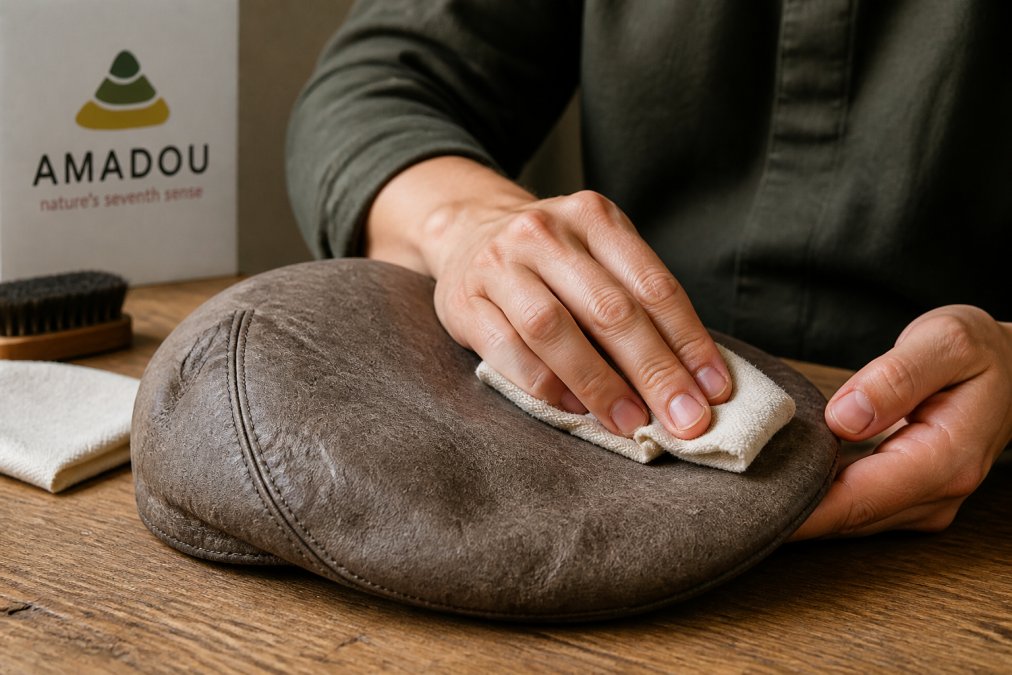
Everyday Care and Storage
Brush or wipe the surface with a dry, soft cloth after wear to lift dust and oils. Amadou's absorbency means it holds onto whatever it touches, so a quick wipe keeps the surface even. Store hats and bags in a breathable cotton bag rather than a sealed plastic bin, which traps moisture and can encourage mildew.
Cleaning and Reconditioning
For deeper cleaning, use a barely damp cloth and mild soap, then blot dry and air-dry fully. Avoid solvents, alcohol, and abrasive cleaners, which strip the natural oils that give amadou its supple hand. A common mistake is over-washing: amadou doesn't need frequent cleaning, and too much moisture is worse than a little dust.
How Mushroom Leather Ages and Compares to PU and PVC
Mushroom leather ages by developing a patina, while PU and PVC synthetic leathers tend to crack, peel, or flake as their plastic coatings break down. This is the clearest long-term difference between the two categories, and it's the part almost no article explains with a timeline.
What Happens Year by Year
Aging is where mushroom leather and synthetic leather diverge most, and the pattern is fairly consistent across well-made pieces.
Why PU and PVC Fail on a Different Curve
Synthetic leathers are made by coating a fabric backing with polyurethane or polyvinyl chloride. That coating is what gives them their uniform look, and it's also their weak point. The plastic layer and the fabric backing expand and contract at different rates, so every flex and every temperature swing works the bond between them.
The Environmental Angle
On environmental impact, the contrast is just as sharp. Amadou is forest-grown, chemical-free, and biodegradable at end of life, which fits cleanly into a circular economy model rather than a linear one.
Frequently Asked Questions
What are the disadvantages of mushroom leather?
Mushroom leather is softer and more supple than animal leather, so it flexes and stretches with use rather than staying rigid. It absorbs moisture instead of repelling it, so it is not ideal for heavy rain without care. It also develops a patina and marks over time, which some buyers see as a flaw and others see as character. With the right mushroom leather care instructions, an accessory can stay usable for years.
Does mushroom leather require special maintenance to stay durable?
Yes, but it is simple. Keep it dry, store it flat or shaped to avoid creasing, and brush off dust with a soft cloth. Avoid soaking it and skip harsh detergents. Because the material is naturally absorbent, it pulls in oils and moisture quickly, so a light, regular cleaning routine is usually enough to protect the fibers and extend material longevity.
Is mushroom leather water-resistant?
It is moisture-absorbent rather than waterproof. The natural capillary structure soaks up water, sweat, and oils instead of beading them off. That makes it excellent for wicking moisture in a hat or bag lining, but it means you should not treat it like a rain shell. If it gets wet, let it air dry away from direct heat to keep the fibers from stiffening.
How long can you expect a mushroom leather accessory to last?
With regular care, a well-made mushroom leather piece can last several years of daily use. The material is soft and stretchable, so it flexes rather than cracking like some synthetic leathers. Over time it develops a patina and may show small marks, but this aging process is part of the appeal. Avoiding prolonged moisture and rough abrasion will help it hold its shape and texture.