

Table of Contents
- Why Buy Handcrafted Mushroom Leather Bags in 2026
- What Mushroom Leather Is (and Why It Feels Different)
- The Amadou Collection: Handcrafted Mushroom Leather Bags and Prices
- How to Care for Mushroom Leather
- Durability, Longevity, and Repairs: What to Expect Over Years
- Amadou vs Other Premium Vegan Leather Alternative Brands
- Sustainability, Ethics, and the Real Cost of a Mushroom Bag
- Frequently Asked Questions
Last Updated: September 14, 2026
Why Buy Handcrafted Mushroom Leather Bags in 2026
Weekend markets repeat the same stall: mass-produced totes, identical stitching, plastic linings. When you buy handcrafted mushroom leather bags, you choose the opposite, a bag grown from fungus, worked by hand, finished with zero chemicals.
This guide from Amadou covers what the material is, what our collection costs, how to care for it, and how it holds up over years.
The short answer: mushroom leather is a bio-fabricated material grown from fungal tissue rather than raised as livestock hide or synthesized from petroleum. It breathes, develops a patina, and can be repaired by hand.
What Mushroom Leather Is (and Why It Feels Different)
Mushroom leather is a bio-fabricated textile grown from the root-like structures of fungi, then harvested, pressed, and finished by hand. It is not a synthetic imitation of leather; it is a distinct material with its own grain, weight, and hand-feel.
The difference shows the moment you pick a piece up. Where animal hide feels dense and cool and polyurethane vegan leather feels slick and clammy, fungal tissue feels soft and dry, closer to velvet than vinyl, thanks to the trama, the spongy inner layer, which is naturally absorbent and breathable.
Fungal tissue also takes dye differently: fibrous rather than a solid skin, it holds a matte, earthy tone instead of a high-gloss sheen, which is why handcrafted mushroom leather bags look understated rather than flashy.
From Fomes Fomentarius to Finished Bag
The species behind most quality fungal leather is Fomes fomentarius, a hoof-shaped bracket fungus growing on birch and beech. Its inner trama has been used for centuries to make amadou, a felt-like material once carried as tinder and later shaped into hats and small goods (pubmed.ncbi.nlm.nih.gov).
Turning it into a bag takes patience rather than machinery:
- Harvest the bracket fungus from fallen or standing hardwood.
- Separate the hard outer crust from the soft inner trama.
- Soften the trama by hand, working the fibers until they relax into a felt-like sheet.
- Press and shape the sheet into panels sized for the bag.
- Stitch and line the panels, typically with a natural fabric such as linen.
No chemical tanning bath, no plastic coating, shaped by hand, so no two pieces carry the same grain.
The Amadou Collection: Handcrafted Mushroom Leather Bags and Prices
Every bag in the Amadou collection is cut and sewn by hand from cultivated Fomes fomentarius trama and lined with soft linen, from $98 for the small shoulder purse to $169 for the patchwork shoulder bag.
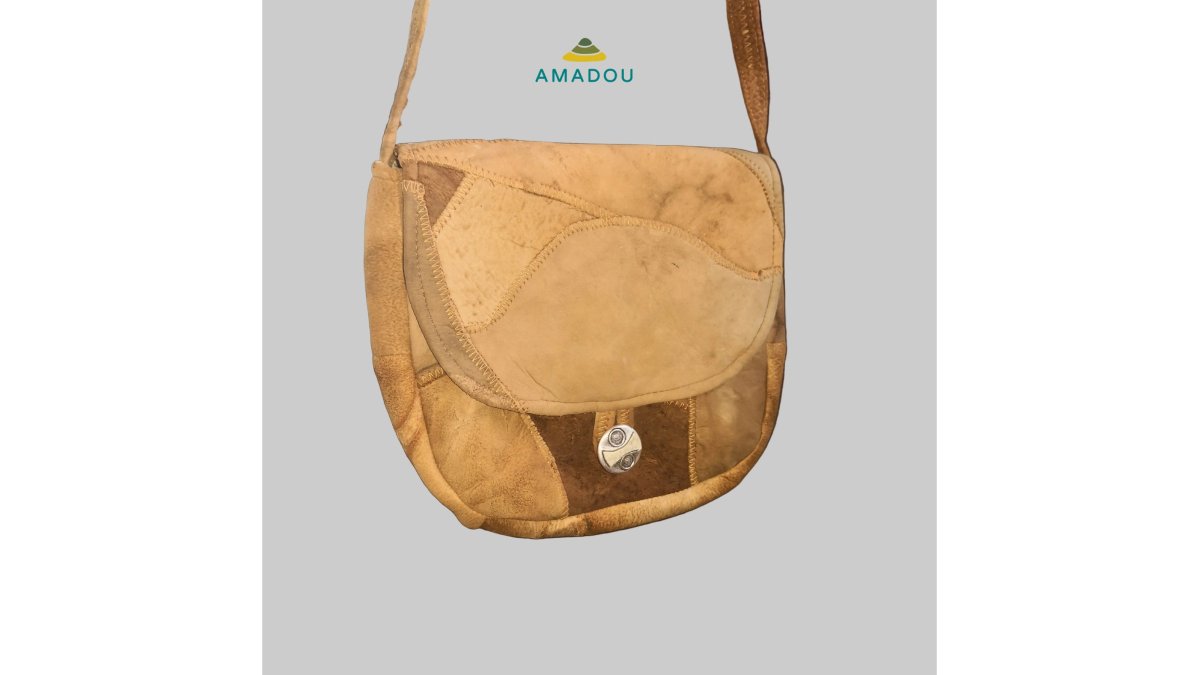
Here is the full lineup side by side:

| Bag | Price | Best For | Signature Detail |
|---|---|---|---|
| Amadou Bag - Patchwork | $169 | Statement everyday carry | Hand-sewn patchwork panels, zero chemicals |
| Legacy Shoulder Bag, Big | $135 | Daily commutes and travel | Roomy single-shoulder silhouette |
| Legacy Shoulder Bag, Small | $98 | Light carry and evenings | Compact, featherweight build |
| Wooden Shoulder Bag Covered with Amadou | $121 | Structured, architectural look | Rigid wood frame wrapped in fungal trama |
Amadou Bag - Patchwork ($169)
The patchwork bag is the most distinctive piece in the range. Each panel is sewn individually, so the grain shifts across the surface and no two bags match. Fully handworked with zero chemicals, lined in soft linen, and cut for shoulder wear, at $169 it reads as an artisan object rather than a plain accessory.
Legacy Shoulder Bag, Big ($135) and Small ($98)
The Legacy line is where most first-time buyers land. The big version at $135 carries a laptop, a water bottle, and daily clutter without sagging; the small at $98 is for when you want almost nothing on your shoulder. Both use the same trama construction, the difference is capacity, not quality.
Wooden Shoulder Bag Covered with Amadou ($121)
Our most structured bag: a rigid wooden frame holds its shape even when empty, while the fungal trama covering keeps the surface soft to the touch, ideal if you want a bag that stands up on its own rather than slouching into a pile.
How to Care for Mushroom Leather
Caring for mushroom leather is mostly about restraint: fungal trama is a felted, absorbent fiber mat, not a sealed skin. Wax, silicone spray, or heavy conditioner clogs the fibers that give the material its breathability and its ability to recover its grain. Most care mistakes are over-treatment, not neglect.
The Weekly Routine
- Brush, do not scrub. A soft horsehair brush or a clean dry microfiber lifts dust out of the grain. Work in one direction along the panel, not in circles, so you do not raise fuzz.
- Spot-clean with a barely damp cloth. Wring it until almost dry, then blot, do not rub. For oily marks, use a drop of mild dish soap in a cup of water, then blot with plain water.
- Air-dry away from heat. Set the bag in a shaded, ventilated spot. Never use a hair dryer, radiator, or direct sun, rapid drying stiffens the felted fibers and can set a crease.
- Skip the conditioner. Trama does not need oil the way animal hide does. If the surface feels dry after a soak, hand-massage the panel to redistribute natural oils.
- Store loosely. Stuff with crumpled acid-free tissue or a clean cotton cloth to hold its shape, and keep it out of prolonged direct sun, which fades the earthy dye tones.
- Rotate your carry. Giving a bag a day off lets compressed fibers rebound, the same way a wool sweater recovers between wears.
Seasonal and Storage Notes
Humidity is the one variable that changes the routine. In a dry climate, a fungal bag can feel stiff after a cold snap; a few hours at room temperature restores it. In a humid climate the risk flips, trapped moisture feeds mold, so the bag needs airflow, not a sealed container.
- Summer: Wipe the strap and base after sweaty commutes. Salt and sweat dull the surface fastest.
- Winter: Let a snow-dampened bag dry at room temperature before storing. Do not set it near a vent.
- Long-term storage: Use a breathable cotton dust bag, not plastic. If the closet runs damp, add a small cedar block or silica packet nearby, not inside the bag.
What Not to Do
- No washing machine, no dryer, no soaking.
- No leather creams, waxes, or waterproofing sprays.
- No bleach, vinegar, or alcohol-based cleaners.
- No plastic storage bags or vacuum-sealed bins.
- No prolonged direct sunlight on a single panel.
Treat a fungal bag like a fine wool garment, not a nylon one, and it will outlast most of the synthetic vegan leather in your closet.
Durability, Longevity, and Repairs: What to Expect Over Years
Most guides stop at the sustainability pitch and never say what a fungal bag looks like after a year of daily carry, the question that decides whether a $169 purchase is worth it. Here is the honest timeline, the failure points, and the repairs.
How a Fungal Bag Ages: A 1-3 Year Timeline
Long-term owners report a three-phase aging curve. Exact timing depends on carry frequency and climate, but the shape is consistent.
Months 1-6, Break-in. The trama softens and darkens slightly at the strap and top edge where hand and shoulder contact it most. This is not wear but felted fibers compacting into a denser, more durable surface; the bag feels more supple at month six than the day it arrived.
Months 6-18, Patina. The tone deepens a shade or two, unevenly, led by the highest-contact areas, and grain becomes more visible as the surface relaxes. Stitching stays tight because hand-sewn linen thread does not stretch like machine thread. Most owners say it looks better than new.
Months 18-36, Stress-point settling. The bag is fully broken in. Watch the strap anchors, base corners, and the seam where the lining meets the shell, the same stress points any soft-sided bag has, and exactly where a hand-sewn fungal bag can be repaired rather than replaced.
What you will not see, if the bag is cared for: cracking, flaking, or peeling. Those are failure modes of coated synthetic leathers, where a plastic top layer separates from a fabric backing. Fungal trama has no coating to separate, so it wears by compacting and darkening rather than delaminating.
The Four Failure Points and How to Repair Each
1. Strap anchor loosening. The stitch where the strap meets the body takes the most load. If a stitch starts to pull, stop carrying the bag by that strap and have it re-stitched with waxed linen thread before the hole enlarges.
2. Base corner wear. Corners abrade against tables and car seats.
3. Lining separation. The linen lining is stitched, not glued. Do not glue it; glue stiffens the surrounding trama and creates a hard edge that will abrade the shell.
4. Surface compression or shine. Not damage, and no repair needed. Reshape the panel by hand and let the bag rest overnight; if a shine persists, a light dry-brush with a soft horsehair brush redistributes the surface fibers.
What Genuinely Damages the Material
Three avoidable things shorten a fungal bag's life:
- Repeated soaking. Water will not destroy the bag once, but repeated soak-and-dry cycles weaken the felted structure. Treat it like wool.
- Sealed storage. Trapped moisture encourages mold, the one thing that permanently damages trama. Breathable storage prevents it.
- Abrasion against rough surfaces. Concrete, brick, and unfinished wood fuzz the surface faster than smooth surfaces. This is cosmetic, not structural, and can be brushed back.
When to Repair vs. When to Retire
A fungal bag rarely reaches a point where it must be retired. The realistic decision points: a strap anchor torn through the shell (repairable with a patch), a base worn through to the lining (repairable with a corner patch), or mold penetrated deep into the trama (usually not worth repairing).
Amadou vs Other Premium Vegan Leather Alternative Brands
Shopping for premium vegan leather alternative brands means choosing between three material families, with sharply different trade-offs.
PU and PVC leather is the cheapest and most common: petroleum-based, does not breathe, tends to crack where it flexes, and sits in landfill for a very long time (the EPA).
Plant-based leathers from cactus, apple, or grape waste are a step up, better feel, agricultural byproducts, but many are still bonded to a plastic backing layer, which limits how much they can break down.
Fungal leather is grown rather than manufactured: breathable, lightweight, and producible without chemical tanning. The catch is supply, it is slower to make, which keeps prices higher and output limited.
That trade-off is the honest reason to choose fungal over the alternatives: you pay for a material that behaves and ages like a natural textile, not a plastic sheet with a green label.
Sustainability, Ethics, and the Real Cost of a Mushroom Bag
The environmental case for fungal leather rests on what it replaces. Raising livestock for hides carries a heavy land, water, and methane burden, and the environmental impact overview from the EPA is a useful starting point for understanding how material choices feed into waste and emissions.
Fungal leather sidesteps most of that: grown from renewable resources on agricultural or forestry waste, no chemical tanning bath, produced in a controlled environment rather than on grazing land, and the leftover substrate can be composted rather than discarded.
The ethical side matters just as much. A fungal bag involves no animal slaughter and no toxic tanning runoff, and handcraft keeps the work with artisans rather than a factory line. When you buy handcrafted mushroom leather bags, a meaningful share of the price is labor, not material.
That is why the price is what it is: a $98 purse and a $169 patchwork bag reflect hours of handwork, not a markup on a mass-produced item. If a fungal bag is dramatically cheaper elsewhere, ask what was skipped.
Frequently Asked Questions
How much does a mushroom leather bag cost?
Handcrafted mushroom leather bags from Amadou range from $98 for the small Legacy shoulder purse to $169 for the patchwork bag. The big Legacy shoulder bag is $135, and the wooden shoulder bag covered with amadou is $121. Each is a one-time purchase, fully handmade with zero chemicals, and priced by size, lining, and construction rather than by a seasonal markup. Because the material is grown and worked by hand in small batches, output is limited, which keeps pricing steady rather than discounted.
How durable are mushroom leather bags compared to real leather?
Mushroom leather bags hold up well with normal use, but they age differently than cowhide. The material is soft and breathable, so it creases and develops a patina instead of stiffening. It resists everyday wear from keys, phones, and fabric rubbing. Avoid soaking it, store it dry, and expect years of use rather than decades of armor-like rigidity.
How do I care for a mushroom leather bag day to day?
Keep it dry first. Wipe surface dust with a soft dry cloth. Never machine wash, soak, or use alcohol-based cleaners. If the bag gets wet, let it air dry away from direct heat and reshape it by hand while damp. Store it stuffed with soft cloth in a breathable cotton bag, not plastic, and rotate it rather than wearing the same bag daily.
Is mushroom leather actually vegan and cruelty-free?
Yes. Amadou bags contain no animal hide, no gelatin binders, and no chemical tanning agents. The material comes from the trama of the Fomes Fomentarius mushroom, a non-animal source, and the bags are lined with linen. That makes them suitable for vegan wardrobes and for buyers avoiding chrome-tanned leather.
The real challenge with fungal leather is not finding it, it is finding a maker who treats it as a craft rather than a trend. Amadou exists for exactly that reason: we work the trama of Fomes fomentarius by hand into weightless, moisture-wicking bags that breathe in summer and stay soft in the cold. Each piece develops its own character as it ages, and every bag is finished with zero chemicals and lined in natural linen.
Shop the amadou collection and carry something grown, not manufactured.