

Table of Contents
- The Durability Question: Mushroom Leather vs Traditional Leather
- How Mycelium and Amadou Are Made: A Durability Story
- Tensile Strength, Abrasion Resistance, and Flex Cycles
- Aging, Patina, and Longevity of Fungal Textiles
- The Pros and Cons of Mushroom Leather
- How to Care for Mushroom Leather
- Best Sustainable Alternatives to Leather
- Conclusion
- Frequently Asked Questions
Last Updated: September 20, 2026
The Durability Question: Mushroom Leather vs Traditional Leather
Mushroom leather durability is the measure of how well a mycelium-based material resists tearing, scuffing, and everyday wear compared with animal hides. The short answer: quality fungal textiles hold up well in normal use, but they are not yet a straight swap for heavy-duty cowhide in every application. This guide from Amadou examines how these materials actually perform, based on material science.
Here is what most guides get wrong. They treat "mushroom leather" as one material when it is really a family of products with very different performance. A thin, mass-produced sheet behaves nothing like a dense, hand-pressed amadou made from Fomes Fomentarius trama.
Below, we break down tensile strength, abrasion resistance, flex cycles, aging, and care so you can judge durability for yourself.
How Mycelium and Amadou Are Made: A Durability Story
Mycelium leather is a bio-based material grown from fungal roots, then processed into a flexible sheet that can replace animal hides or synthetic leather. How it is grown and finished determines almost everything about how long it lasts.
Most mycelium textiles start in a lab. The fungus feeds on agricultural waste, forming a mat of fibers. That mat is then pressed, tanned, and often bonded to a polymer matrix for strength.
Amadou takes a different, older path. It comes from the trama of the Fomes Fomentarius mushroom, harvested and worked by hand into a soft, felt-like sheet. The fibers are naturally interlocked, which gives the material its stretch and resilience without chemical binders.
That fiber structure is the whole story. A dense, hand-worked sheet resists scuffing and tearing far better than a thin, quickly grown sheet.
Tensile Strength, Abrasion Resistance, and Flex Cycles
Mushroom leather's mechanical properties depend on three things: fiber density, the binder or backing used, and how the sheet was finished. Change any one of them and you get a different material. That is why two products both sold as "mushroom leather" can behave nothing alike.
Tensile strength measures how hard you can pull the material before it tears. In practice, a dense, well-pressed fungal sheet lands in the range of a mid-weight animal leather, while thick full-grain hide still wins on raw pulling force. The reason is structural: animal hide is a woven collagen network that runs in three dimensions, while most mycelium sheets are grown as a flat mat and then laminated to a backing fabric or polymer film. When a mycelium sheet fails, it usually fails at that bond line, the fibers themselves hold, but the layers separate. Amadou behaves differently because its fibers are naturally interlocked in the trama of the Fomes Fomentarius mushroom, so there is no glue line to delaminate.
Abrasion resistance is measured in the lab with a Martindale or Taber test, which rubs the material against an abrasive wheel or cloth under a set load and counts the cycles until the surface breaks down. Dense amadou handles keys, zippers, and pocket corners well because the interlocked fibers distribute the scuff instead of letting it dig in. Thin, quickly grown mycelium sheets are the opposite: at high-friction points like a bag's bottom corner or a strap's edge, they can wear through in a matter of months of daily use.
Flex cycles matter for anything that bends repeatedly, straps, hinges, bag flaps, hat brims. A material can be strong in tension and still crack in flex if it is stiff or if the binder embrittles over time. Here is how the two families compare in practice:
| Property | Quality Mushroom Leather | Traditional Leather |
|---|---|---|
| Tensile strength | Mid-weight range; delamination is the common failure | High in full-grain; tears only under extreme load |
| Abrasion resistance | Good in dense, interlocked sheets | Excellent; surface scuffs rather than wears through |
| Flex cycles | High before cracking when binder stays flexible | High; creases rather than cracks |
| Water resistance | Moderate; absorbs and dries | Moderate to high; benefits from wax or oil |
| Breathability | High | Moderate |
| Failure mode | Delamination or edge fray | Surface scuff, then crack at crease |
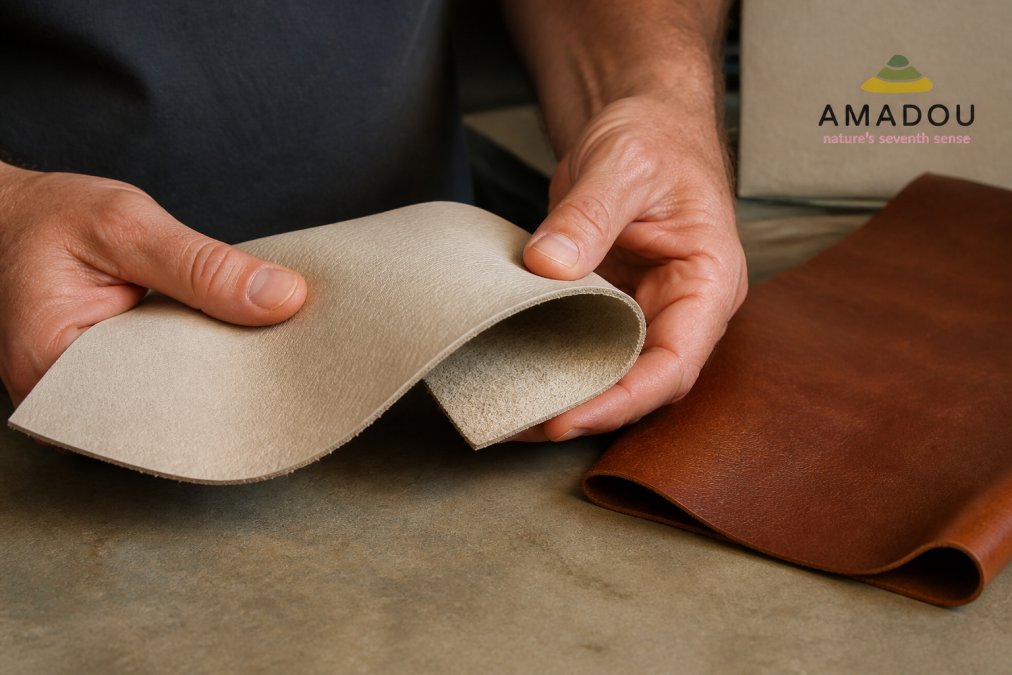
The takeaway: for bags, hats, and low-stress accessories, quality fungal textiles perform well. For heavy load-bearing gear, work boots, tool belts, saddlery, animal hide still leads, mainly because it tolerates repeated stress without separating at a bond line.
Aging, Patina, and Longevity of Fungal Textiles
Fungal textiles age rather than fail. With normal use, amadou develops a soft patina, darkening slightly and taking on the character of the wearer. But "ages gracefully" is not the same as "lasts forever," and the difference comes down to what is happening at the fiber level.
Amadou's fibers are naturally interlocked and lignin-rich, which is what gives the material its felt-like resilience. Over time, handling compresses the surface fibers and burnishes them, which is the patina you see. The fibers themselves do not dry out and crack the way poorly maintained animal leather can, because there is no collagen to lose moisture. That is a real structural advantage, but it is not unconditional.
The three things that shorten a fungal textile's life are moisture, prolonged UV, and heat:
- Moisture. Amadou absorbs water and dries slowly. Occasional rain is fine; storing a damp piece in a sealed bag is not. Trapped moisture encourages mold, which digests the very fibers the material is made of.
- UV. Long exposure to direct sun breaks down lignin and causes the surface to fade and go brittle at the edges. A hat left on a car dashboard all summer will show it.
- Heat. Radiators, hot cars, and tumble dryers can stiffen the material and, in bonded mycelium sheets, can embrittle the polymer binder so the sheet cracks at creases.
This is where amadou and mass-produced mycelium sheets diverge. A bonded sheet's lifespan is often set by its binder, not its fibers, when the polymer film stiffens or the lamination fails, the product is done, even if the mycelium itself is intact.
The Pros and Cons of Mushroom Leather
The pros and cons of mushroom leather come down to what you value: sustainability and feel versus maximum toughness.
Pros:
- Vegan and cruelty-free, with no animal hides involved
- Lightweight and breathable, so it stays cool in heat
- Develops unique character with age
- Lower environmental footprint than most synthetic leather
Cons:
- Not as tough as heavy full-grain hide under extreme stress
- Water resistance is moderate, not waterproof
- Quality varies widely between makers
How to Care for Mushroom Leather
To care for mushroom leather, keep it dry, clean it gently, and store it away from prolonged moisture and direct heat. That is the entire routine, and it is simpler than most people expect.
- Wipe surface dust with a dry, soft cloth weekly
- Spot-clean marks with a barely damp cloth, then air dry
- Avoid soaking, machine washing, and tumble drying
- Store in a breathable bag, not sealed plastic
- Keep away from radiators and direct sun for long periods
Best Sustainable Alternatives to Leather
The best sustainable alternatives to leather fall into three groups: fungal textiles, plant-based sheets, and recycled synthetics. Each trades some durability for a lower environmental footprint.
Conclusion
Judging durability fairly means matching the material to the job. Mushroom leather holds up well for bags, hats, and daily accessories, and amadou's dense, hand-worked fibers give it a real edge over thin, mass-produced sheets. Where you need maximum toughness under heavy load, animal hide still wins. For everything else, fungal textiles are a serious, durable choice.
Frequently Asked Questions
What are the disadvantages of mushroom leather?
Mushroom leather can be less water-resistant than traditional leather and may require more careful maintenance. It can also be more expensive to produce at scale. However, its environmental footprint is significantly lower, and it offers a cruelty-free, eco-friendly alternative. For specific care, follow the manufacturer's guidelines to ensure longevity.
How does the tensile strength of mycelium-based materials compare to cowhide?
Tensile strength varies based on manufacturing. Some mycelium materials can rival cowhide in tensile strength, especially when combined with a polymer matrix. However, traditional leather often excels in tear resistance. The durability of mushroom leather depends on the specific product and its intended use, so check product specifications.
Does mushroom leather develop a patina like traditional leather?
Yes, many mushroom leather products develop a patina over time, similar to traditional leather. This aging process adds character and uniqueness. The patina results from exposure to oils, sunlight, and handling. To encourage an even patina, regularly clean and condition the material as recommended by the maker.
Is mushroom leather water-resistant enough for daily use?
Mushroom leather is generally water-resistant but not fully waterproof. It can handle light rain and spills, but prolonged exposure to moisture may cause damage. For daily use, apply a protective spray if recommended. Always dry naturally away from direct heat. For heavy rain, consider a different material or treat it with a water-repellent finish.
The real challenge is finding fungal material made well enough to last. Amadou addresses that by crafting accessories from the trama of the Fomes Fomentarius mushroom, using dense, hand-worked sheets that resist scuffing and develop character with age. The result is a vegan, breathable alternative that stays cool in the sun and soft against the skin. Shop the amadou collection and choose an accessory built to age beautifully with you.