

Last Updated: October 24, 2026
Quick Summary
Sustainable fashion materials limit harm across fiber production, processing, dyeing, use, and disposal, and no single label settles that. Judge each material on five measurable fronts: carbon footprint, water footprint, land use, energy use, and toxic chemicals. Every material trades one impact for another, so the right choice depends on which impact you want to reduce.
- Certifications like GOTS and the Global Recycled Standard verify a process, not a product's total impact.
- Most recycled fashion material comes from plastic bottles, not old clothes, leaving textile waste untouched.
- Recycled polyester sheds microfibers the same as virgin polyester, so fiber type matters more than the recycled label.
- PU vegan leather coatings crack, peel, and cannot be repaired, and PVC is worse on chemical load.
- Amadou from Fomes fomentarius is breathable, moisture-wicking, and biodegradable, needing spot cleaning and occasional wax reconditioning.
Table of Contents
- What Makes a Fashion Material Truly Sustainable
- Sustainable Fabrics Compared: Natural, Plant-Based, and Cellulosic Fibers
- Recycled Fashion Materials: What Recycling Actually Delivers
- Vegan Leather Alternatives: Performance, Care, and Durability
- Mushroom Leather: How Fomes Fomentarius Amadou Works
- Material Comparison Table: Environmental Impact and Performance
- Choosing Amadou Accessories for Everyday and Travel Use
- Frequently Asked Questions
What Makes a Fashion Material Truly Sustainable
Sustainable fashion materials limit harm across their whole life: fiber production, processing, dyeing, use, and disposal. No single label settles that. At Amadou, we treat material claims as arguments to be tested, not badges to be trusted.
A 2024 study on how perceived sustainability influences clothing choices found that shoppers' perceptions of a garment's sustainability shape what they buy, even when those perceptions rest on marketing rather than measurement.
The Five Metrics That Decide the Answer
Judge a material on five measurable fronts:
- Carbon footprint per kilogram of fiber, from field or feedstock to finished yarn
- Water footprint, which swings wildly between irrigated and rain-fed crops
- Land use and whether that land competes with food
A material can win on one and lose badly on another. Organic cotton slashes chemical load but still drinks water. Recycled polyester avoids virgin petroleum but sheds microplastics.
Certifications and Their Limits
Certifications verify a process, not a product's total impact. GOTS covers organic fiber and processing chemicals; the Global Recycled Standard traces recycled content. Neither audits carbon or guarantees a garment lasts. Use certifications as a floor, then ask the harder questions about durability and end of life.
Sustainable Fabrics Compared: Natural, Plant-Based, and Cellulosic Fibers
Plant-based fibers split into two families, and the distinction matters more than most buyers realize. Natural fibers arrive close to how the plant grew them. Cellulosic fibers are engineered from plant pulp, which means their impact depends almost entirely on the mill.
Organic Cotton, Hemp, and Linen
Organic cotton eliminates synthetic pesticides and fertilizers, cutting the chemical burden on farmworkers and waterways. Conventional cotton remains one of the thirstiest, most pesticide-intensive textile crops. The organic label addresses farming, not dyeing.
Hemp and linen need less irrigation and fewer inputs than cotton in most regions, and both are strong. The catch is processing: retting and mechanical separation are energy-intensive, and conventional softening can reintroduce the chemical problem you were avoiding.
Lyocell, Bamboo, and Other Cellulosic Fibers
Lyocell uses a closed-loop solvent that recovers most of the chemical, earning it a better reputation than viscose. Bamboo is the cautionary tale: bamboo fabric is usually viscose made from bamboo pulp, and the label says nothing about the process. Closed-loop bamboo lyocell is a different material from chemically intensive bamboo viscose.
Recycled Fashion Materials: What Recycling Actually Delivers
Recycled content is real, but not a closed loop. Most recycled fashion material comes from plastic bottles, not old clothes, keeping bottles out of landfills while leaving textile waste untouched.
Recycled Polyester and Microfiber Shedding
Recycled polyester cuts demand for virgin petroleum and keeps PET bottles in circulation, but it does not fix shedding. Every synthetic garment releases microfibers in the wash, a documented source of microplastic pollution. A recycled synthetic sheds the same as a virgin one, so fiber type matters more than the recycled label.
Deadstock and Textile-to-Textile Recycling
Deadstock, surplus fabric mills and brands never used, is genuinely low-impact because the fiber already exists. But supply is finite, inconsistent in color and quantity, and impossible to scale into a core line. Textile-to-textile recycling is the more important frontier, still limited by sorting costs and fiber quality, so treat "fully circular" claims with skepticism.
Vegan Leather Alternatives: Performance, Care, and Durability
Most vegan leather alternatives are polyurethane (PU) or PVC coatings on a fabric backing. They avoid animal hide but are petroleum-based and typically fail faster than leather: the coating cracks, peels, and cannot be repaired. PVC is worse on chemical load and end of life; PU is more common but still petroleum-derived and landfill-bound.
The Main Material Families
Plant-based leathers built from agricultural waste, fruit byproducts, and fungal material are the more interesting category. Performance varies enormously by feedstock and processing:
- Fruit and plant-waste leathers (apple, grape, cactus, pineapple leaf) are usually plant waste combined with a binder, often PU. The plant content is real, but the binder determines durability and end of life. Some are thin and decorative; others hold shape and handle moisture.
- Fungal and mycelium leathers use fungal tissue rather than animal hide or petroleum. The best-known version comes from Fomes fomentarius, the tinder fungus, whose inner layer, called amadou, has been processed in Europe for centuries. The result feels closer to suede than to plastic: breathable, naturally moisture-wicking, and warm to the touch. It ages into a patina rather than cracking.
- Bacterial cellulose and bio-fabricated leathers are emerging but limited in commercial scale. Treat readiness claims with caution: a material can be innovative and still not available in consistent quantity or quality.
Performance and Care by Material
Care differs by material, and the wrong cleaner ruins them. PU and PVC coatings wipe clean but degrade with heat and flexing. Plant-waste leathers with PU binders need gentle cleaning and often cannot be repaired once the binder fails. Fungal amadou needs spot cleaning, dry storage, and occasional wax reconditioning. For specific brands, see our guide to premium vegan leather alternative brands.
Transylvanian forest charm / Amadou Bracelet →
Greenwashing Checks
"Vegan" means no animal ingredients; it does not mean biodegradable, low-carbon, or non-toxic. A plant-based label can sit on top of a PU binder. Ask the harder questions: What is the binder? What percentage is bio-based? Is it repairable? What happens at end of life?
Mushroom Leather: How Fomes Fomentarius Amadou Works
Mushroom leather is made from fungal tissue rather than animal hide or petroleum. The best-known version comes from Fomes fomentarius, the tinder fungus, whose inner layer, amadou, has been processed in Europe for centuries.
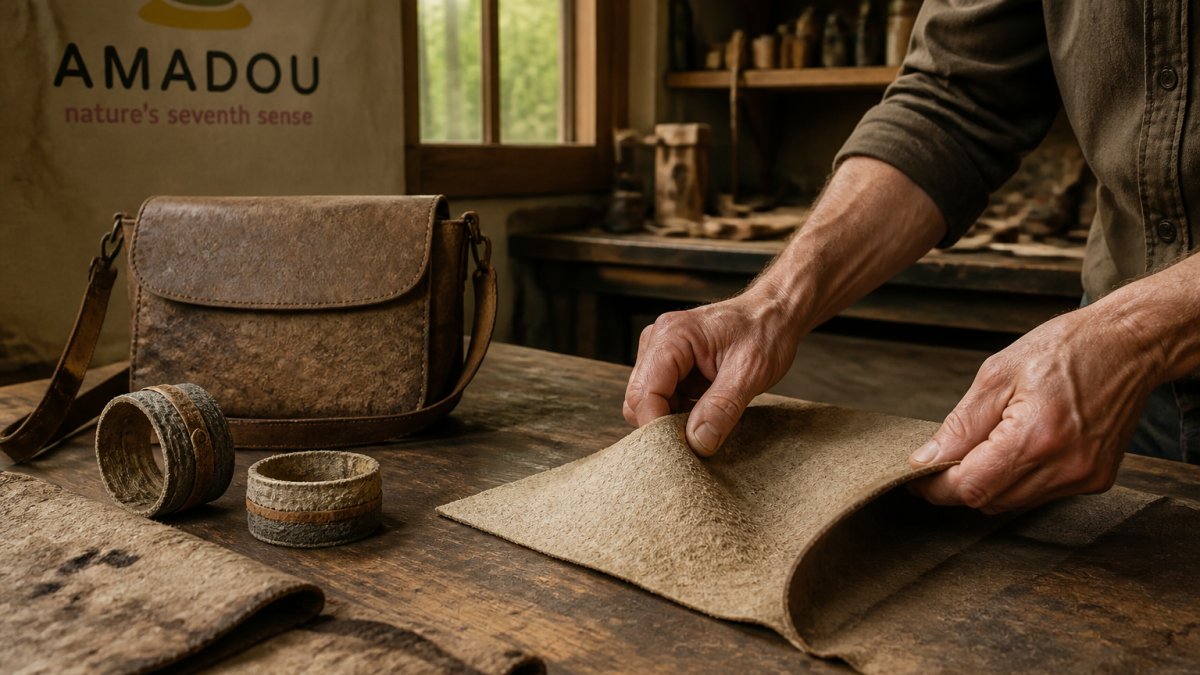
The process is slow and largely manual: the fungus is harvested, boiled, stretched, and worked until the fibrous trama becomes soft, felt-like, and remarkably light. Our Transylvanian forest charm amadou bracelet lets you experience it firsthand.

Material Comparison Table: Environmental Impact and Performance
Most sustainable fashion materials roundups hand you a single score and move on, hiding the trade-offs. The table below compares the main material families across the metrics that decide a garment's footprint, plus the performance and care questions that determine how long it stays in use. Ratings are relative and depend on how a fabric is produced, dyed, and finished.
| Material | Feedstock | Carbon footprint (relative) | Water use (relative) | Land use (relative) | Chemical load | Durability | Breathability | Care requirements | End of life | Best for |
|---|---|---|---|---|---|---|---|---|---|---|
| Organic cotton | Plant | Moderate | High (irrigated) to moderate (rain-fed) | High | Low | Moderate | High | Machine wash cold, line dry | Compostable, but slow | Breathable everyday wear |
| Conventional cotton | Plant | Moderate to high | Very high (irrigated) | High | High (pesticides, fertilizers) | Moderate | High | Machine wash cold, line dry | Compostable, but slow | Low-cost basics |
| Hemp | Plant | Low | Low | Moderate | Low | High | Moderate | Machine wash, softens with use | Compostable | Long-wear basics, workwear |
| Linen (flax) | Plant | Low | Low (rain-fed) | Moderate | Low to moderate (retting, softening) | High | High | Machine wash, air dry, iron damp | Compostable | Warm-weather wear, home textiles |
| Lyocell | Wood pulp | Low to moderate | Moderate | Moderate (managed forests) | Low (closed-loop solvent) | Moderate | High | Gentle wash, low heat | Partly recyclable, biodegradable | Drape, softness, athletic wear |
| Viscose/rayon | Wood or bamboo pulp | Moderate to high | Moderate to high | Moderate to high | High (solvent recovery varies) | Low to moderate | High | Gentle wash, low heat | Hard to recycle, biodegradable | Low-cost drape |
| Recycled polyester | Plastic bottles | Low (avoids virgin petroleum) | Low | Low | Moderate | High | Low | Wash cold, use a microfiber filter bag | Hard to recycle; sheds microfibers | Performance gear, outerwear |
| Virgin polyester | Petroleum | High | Low | Low | Moderate | High | Low | Wash cold, use a microfiber filter bag | Hard to recycle; sheds microfibers | Low-cost performance wear |
| PU vegan leather | Petroleum | High | Low | Low | High | Low (coating cracks) | Low | Wipe clean, avoid heat | Landfill | Low-cost fashion |
| Amadou (fungal) | Mushroom | Minimal | Low | Low | Minimal | Moderate, ages well | High | Spot clean, keep dry, recondition with wax | Biodegradable | Lightweight accessories |
How to Read the Table
No material wins every column. Organic cotton slashes chemical load but still drinks water. Recycled polyester avoids virgin petroleum but sheds microfibers and is hard to recycle at scale. Hemp and linen are strong on land, water, and durability, but conventional softening can reintroduce chemical problems. Lyocell's closed-loop solvent beats viscose only if the mill actually recovers it.
The Metrics That Matter Most
- Carbon footprint per kilogram of fiber, field to finished yarn. Recycled polyester beats virgin polyester here, but not hemp or linen.
- Water footprint, which swings wildly between irrigated and rain-fed crops. Organic cotton is a chemical solution, not a water one.
- Land use and whether it competes with food. Hemp and linen are more land-efficient than cotton in most regions.
Performance and Care: The Missing Half of the Comparison
Durability, comfort, breathability, washing, and repairability determine how long a garment stays in use, and longer use is usually the biggest environmental win. Hemp and linen outlast cotton and soften with washing. Lyocell drapes well but needs gentle wash and low heat. Recycled polyester is durable but low on breathability and sheds microfibers; a filter bag reduces release. PU vegan leather cracks and cannot be repaired.
Choosing Amadou Accessories for Everyday and Travel Use
Lightweight, breathable accessories solve a real travel problem: felt and heavy leather become uncomfortable in heat and slow to dry after rain.
The patchwork amadou shoulder bag handles daily carry with a linen lining and hand-sewn construction. Travelers wanting more room should look at the large legacy shoulder bag; the small legacy shoulder purse suits lighter days.


Best for: travelers and daily carriers who want a breathable, plant-based bag that ages gracefully. Skip if: you need a structured, water-resistant bag for heavy rain or rugged terrain.
The hard part of buying sustainable accessories is separating genuine material innovation from marketing.
Frequently Asked Questions
What are the most sustainable materials for fashion?
There is no single winner, because sustainability depends on fiber, farming method, dyeing, transport, and how long the item lasts. Organic cotton, hemp, and linen score well on land use and biodegradability but need water and land. Lyocell uses closed-loop solvent recovery. Recycled polyester diverts plastic waste but still sheds microfibers. Mushroom leather such as amadou avoids animal hide and heavy chrome tanning. Judge a material by durability, traceability, and end-of-life, not by a single eco label.
Is mushroom leather a sustainable alternative to animal leather?
It can be, with caveats. Amadou from Fomes fomentarius is a plant-based material harvested from a wild fungus and processed without chrome or plastics in Amadou's workshop process, which avoids the heavy chemical load of conventional chrome tanning. The trade-offs are scale and care: it is produced in small batches, so supply is limited, and it needs gentle handling rather than soaking. Ask any brand where the material is grown and who processes it before you treat the claim as verified.
Are recycled fabrics better for the environment than natural fabrics?
Not automatically. Recycled polyester keeps plastic out of landfill and needs less virgin petroleum, but washing it releases microfibers into waterways, and most textile recycling today is mechanical downcycling rather than true fiber-to-fiber recycling. Natural fibers biodegrade and support farm livelihoods but carry water, land, and pesticide costs. The practical test is longevity: a recycled bag you carry for ten years beats a natural one you replace every season.
How can you tell whether a fashion material is truly sustainable?
Look for specifics rather than adjectives. A credible brand can name the fiber source, the processing method, the country of manufacture, and any third-party certification such as GOTS for organic cotton or the Global Recycled Standard for recycled content. Be cautious with vague terms like eco-friendly or green, which have no legal definition in US marketing. Certifications also have limits: they verify a process, not a whole product's footprint, so pair them with questions about durability and repairability.
What sustainable materials are best for bags and accessories?
For bags and small accessories, prioritize abrasion resistance and how the material ages. Hemp canvas and heavy linen wear well and biodegrade. Recycled polyester is light and water-resistant but sheds fibers. Vegan leather alternatives vary widely: PU-coated versions crack over time, while amadou mushroom leather develops a suede-like patina and stays lightweight. Amadou's patchwork shoulder bag at $169 and small legacy purse at $98 use mushroom leather with linen lining, and the $25 bracelet is an low-cost way to test the material's feel before committing.
Will a mushroom leather hat or bag handle moisture and sweat while traveling?
Amadou is naturally absorbent and moisture-wicking, which is why it feels dry against skin in heat and works as a screen-cleaning cloth. That same absorbency means it should not be soaked or machine washed. For travel, treat it like suede: brush off dust, blot spills, and let it air dry away from direct heat. It is lightweight and packs flat, which suits hiking and city trips, but it is not a waterproof technical fabric, so pair it with a dry bag in heavy rain.
