

Table of Contents
- The 2026 Mushroom Leather Landscape: How These Two Brands Compare
- Mushmycel vs Elyse Breanne Design: A Side-by-Side Technical Comparison
- The Benefits of Mushroom Leather Accessories for Everyday Use
- Is Mushroom Leather Durable? What to Expect Over Time
- How to Care for Mushroom Leather: A Practical Guide
- Environmental Footprint and End-of-Life Considerations
- Which Brand Is Right for You? A Decision Framework
- Conclusion: Making an Informed Choice for Sustainable Style
- Frequently Asked Questions
Last Updated: September 24, 2026
The 2026 Mushroom Leather Landscape: How These Two Brands Compare
Mushroom leather comparison has moved from novelty to genuine buying decision. The mushmycel vs elysebreannedesign comparison sits at the center of that shift, and this guide from Amadou breaks down how the two approaches differ. Both brands work with mycelium and other bio-based materials, but they solve different problems for different buyers. One leans toward a cultivated, lab-grown material with consistent output; the other leans toward small-batch, design-forward pieces.
Mushmycel vs Elyse Breanne Design: A Side-by-Side Technical Comparison
Mushmycel and Elyse Breanne Design diverge most on material composition and how transparent each is about its supply chain. Mushmycel centers on cultivated mycelium sheets grown on agricultural waste. Elyse Breanne Design tends toward smaller runs with a stronger design and craft emphasis.
Material Composition and Sourcing
Mycelium-based material is grown by feeding fungal spores a substrate, often agricultural waste like sawdust or crop residue, then harvesting and finishing the resulting mat. Mushmycel's model depends on controlled growth for consistency. Elyse Breanne Design's pieces read more like artisan goods, where variation is part of the appeal. The EPA guidance on sustainable materials is a useful reference for what "bio-based" actually covers.
Production Methods and Supply Chain Transparency
Production scale shapes everything downstream. A cultivated process can standardize thickness and color; a handcrafted process cannot, and usually does not try. Ask each brand where the material is grown, who finishes it, and whether they publish that chain. Transparency is the clearest signal of whether a claim holds up. For a deeper look at how one maker handles this, see the FTC guidance on environmental marketing claims, which sets the bar for "eco-friendly" language.
| Factor | Mushmycel | Elyse Breanne Design |
|---|---|---|
| Material base | Cultivated mycelium | Mycelium and mixed bio-based |
| Production scale | Larger, standardized | Small-batch, artisan |
| Texture consistency | High | Varies by piece |
| Supply chain detail | Published process | Design-led, less technical |
| Best for | Uniform everyday pieces | Statement, one-off designs |
The Benefits of Mushroom Leather Accessories for Everyday Use
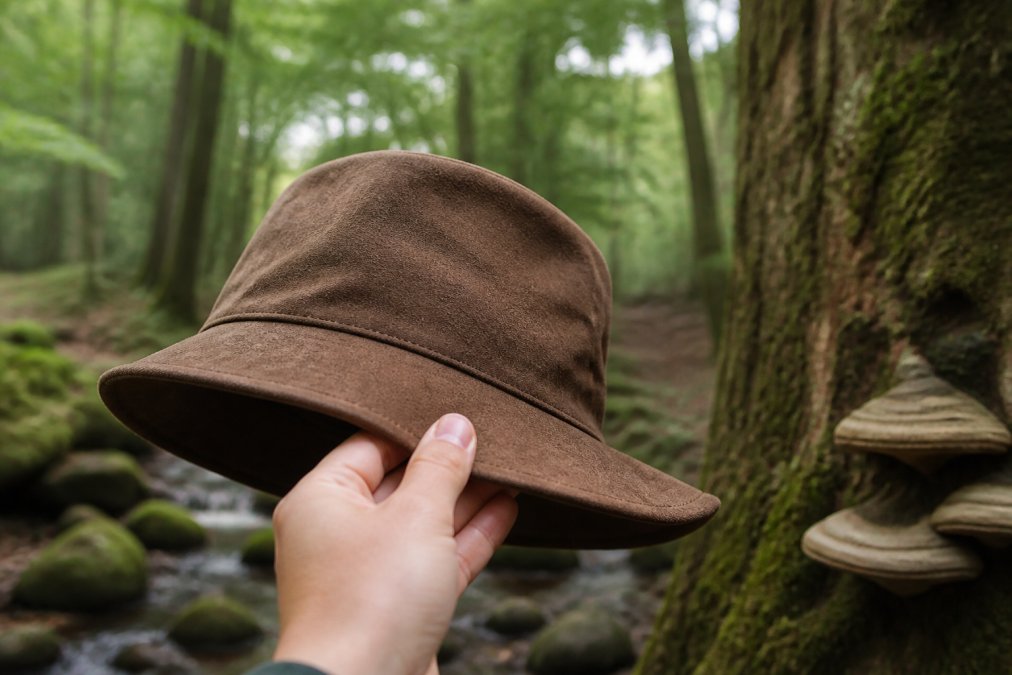
Mushroom leather accessories earn their place through weight, breathability, and comfort rather than brute toughness. A mycelium hat or bag stays light on the body, wicks moisture on warm days, and feels soft against skin. That combination suits daily wear better than heavy felt or stiff hide.
Is Mushroom Leather Durable? What to Expect Over Time
Mushroom leather durability depends on how the material is grown, finished, and worn. Well-made mycelium holds up to daily use, but it ages differently than cowhide. Expect softening and character rather than the stiff patina of traditional leather. The useful question is not "is it durable" but "which construction choices make it durable", and that is where most comparisons stop short.
Tensile Strength and Abrasion Resistance
Tensile strength in mycelium comes from the density of the fungal network and the finishing process. A tightly grown, well-finished sheet resists tearing better than a loose one. Three variables drive that density:
- Substrate: Mycelium grown on a fine, consistent substrate (sawdust, milled crop residue) knits into a denser mat than mycelium grown on coarse or mixed waste. Denser mat, higher tear resistance.
- Growth time and compression: Sheets pressed and dried under controlled pressure finish thinner and tighter than loosely harvested mats. Thickness alone is not strength, a thin, dense sheet often outperforms a thick, spongy one.
- Backing and coating: A mycelium sheet laminated to a woven textile backing gains dimensional stability and resists stretching at stress points. An unbacked sheet is more breathable but more prone to distortion.
How Mushroom Leather Ages Compared to Traditional Leather
Traditional leather stiffens and darkens with a hard-wearing patina. Mycelium-based material tends to soften and develop a lived-in texture. That is a feature for some buyers and a drawback for others. If you want a piece that looks newer longer, traditional leather wins. If you want something that grows more personal with time, mushroom leather delivers.
The aging curve differs by construction type:
- Backed and coated mycelium holds its shape and color longer but can delaminate or crack at the coating if flexed repeatedly in cold weather.
- Unbacked, densely grown mycelium softens gradually and takes on a suede-like nap; it is more forgiving of flexing but more vulnerable to moisture.
- Hand-shaped, wild-harvested material (the amadou tradition) behaves more like felt than like hide, it compresses rather than stretches, and it can be re-shaped with gentle steam.
What Actually Shortens Lifespan
Most premature failure traces back to four causes, none of which are inherent to the material:
- Over-wetting, soaking breaks the fiber bonds that give mycelium its structure.
- Solvent cleaners, alcohol and petroleum-based products strip natural oils and coatings.
- Prolonged UV exposure, direct sun fades dyes and embrittles thin sheets.
- Crushing storage, storing a hat or bag under weight sets permanent creases that never fully relax.
How to Care for Mushroom Leather: A Practical Guide
Caring for mushroom leather is simple, and the main rule is restraint. Keep it dry, brush off dust, and avoid anything harsh. Most damage comes from over-cleaning, not under-cleaning.
- Brush surface dust with a soft, dry cloth
- Blot spills immediately; never soak the material
- Store away from direct sun to prevent fading
- Air out after wear instead of sealing in a bag
- Spot-clean only, using a barely damp cloth
- Skip solvents, alcohol, and abrasive pads
Environmental Footprint and End-of-Life Considerations
Environmental footprint is where mushroom leather earns its reputation. Because mycelium grows on agricultural waste, production can turn residue into material rather than drawing on new resources. That fits a circular economy model, and it uses renewable resources instead of synthetic plastics. The EPA guidance on sustainable materials management is a useful reference for how that circular framing is defined.
Why "Biodegradable" Is Usually Conditional
Pure mycelium, the fungal mat alone, dried and finished without additives, will break down in a home compost environment over weeks to months, depending on thickness and moisture. The complication is that most finished accessories are not pure mycelium. They are mycelium bonded to something else:
- Textile backings (woven cotton, polyester, or blends) hold the sheet together but may not biodegrade at the same rate, or at all, if synthetic.
- Coatings and finishes (polyurethane, acrylic, wax blends) provide water resistance and colorfastness but can leave a persistent residue.
- Adhesives used to laminate layers are frequently petroleum-based and are the single most common reason a "biodegradable" claim fails in practice.
How to Evaluate a Brand's End-of-Life Claim
Use these four questions before you buy. They work on any mushroom leather product, not just the two brands here:
- Is the material backed or unbacked? Unbacked mycelium has the cleanest disposal path. Backed material needs the backing identified.
- What is the backing made of? Natural fiber backings (cotton, linen, hemp) compost far more readily than polyester or nylon.
- Are coatings or adhesives disclosed? A brand that names its finish is more credible than one that says "eco-friendly coating."
- Does the brand publish disposal instructions? A specific answer, "compost the unbacked panel, remove the strap", signals the claim was actually tested.
Comparing the Two Approaches on End-of-Life
The cultivated, standardized approach tends to produce more consistent material, which makes it easier to specify and test a disposal pathway, but also more likely to involve engineered backings and coatings that complicate composting. The small-batch, design-led approach often uses simpler construction, which can mean a cleaner end-of-life profile, though it varies piece to piece and is rarely documented.
The Bottom Line on Footprint
Mushroom leather's environmental advantage is real at the front end, waste-derived feedstock, lower resource draw than animal hide, no petroleum-based plastic in the base material. Whether that advantage survives to end of life depends entirely on what the maker bonded to it. Buy on disclosure, not on the label.
Which Brand Is Right for You? A Decision Framework
Choosing between these two comes down to what you value: consistency or character. Use the framework below instead of guessing.
- Want uniform, everyday pieces? Choose the cultivated, standardized approach.
- Want a statement, one-off design? Choose the small-batch, artisan approach.
- Care most about published supply chain detail? Favor the brand that shows its process.
- Care most about end-of-life disposal? Ask both, then decide.
- Want a heritage story and handcraft? Look at makers who preserve traditional methods.
Conclusion: Making an Informed Choice for Sustainable Style
The hard part is not finding mushroom leather. It is knowing which brand's choices match yours. Mushmycel and Elyse Breanne Design both push material innovation forward, but they serve different buyers, and the right pick depends on whether you want consistency or character.
Frequently Asked Questions
What materials does Mushmycel use for their vegan leather?
Some brands create vegan leather from mycelium, the root structure of mushrooms. This bio-based material is grown using agricultural waste streams like sawdust or crop residue. The production process can be designed to be eco-friendly, avoiding synthetic plastics and toxic chemicals. This approach can result in a sustainable alternative that is both biodegradable and renewable.
Is Elyse Breanne Design considered sustainable fashion?
Some brands focus on sustainable and ethical fashion. They are known for using eco-friendly materials and transparent production processes. Their commitment to craftsmanship and a circular economy model makes them a notable name in the sustainable fashion space, appealing to consumers who value ethical sourcing and environmental responsibility.
How does mushroom leather compare to traditional vegan leather?
Mushroom leather offers several advantages over traditional vegan leather, which is often made from polyurethane (PU) or PVC and relies on synthetic plastics. Mushroom leather is bio-based, biodegradable, and produced with fewer toxic chemicals. It also has a unique, natural texture and is often lighter and more breathable, making it a more sustainable and comfortable choice for accessories.
Are Mushmycel products durable for everyday use?
Mushroom leather products can be designed to be durable for everyday use, but their longevity depends on the specific item and how it is cared for. The mycelium material can have good tensile strength and abrasion resistance. However, like all natural materials, it requires proper maintenance. Following care instructions, such as keeping it dry and storing it properly, will help extend its life.
How do I care for my mushroom leather accessories?
To care for mushroom leather, gently wipe it with a soft, damp cloth to remove dirt. Avoid soaking it or using harsh chemicals or alcohol-based cleaners. For deeper cleaning, use a mild soap and water solution, then let it air dry away from direct heat. Store your accessory in a cool, dry place. With proper care, mushroom leather develops a unique patina over time.