

Table of Contents
- What makes Fomes Fomentarius accessories different
- Sustainable alternatives to leather: why mushroom trama wins
- Vegan leather vs mushroom leather: the real differences
- How to care for Amadou accessories
- Performance in the field: moisture, weight, and durability
- Ethical harvesting and the artisans Behind Amadou
- Choosing your Fomes Fomentarius accessory: a buying guide
- Conclusion
- Frequently Asked Questions
Last Updated: September 11, 2026
What makes Fomes Fomentarius accessories different
Fomes fomentarius accessories are wearable goods made from the processed trama of the hoof fungus, a wood-decay polypore whose inner layer becomes soft, felt-like, and absorbent after traditional preparation. This guide from Amadou explains why the material behaves unlike anything else in a wardrobe or pack: light, breathable, and naturally moisture-wicking.
Fomes fomentarius grows as a hoof-shaped fruiting body on birch and beech trees, and inside its hard outer shell sits a layer of densely packed hyphae. Those filaments form a porous structure that soaks up liquid like a sponge without falling apart. When artisans peal,cut along the growing bends and stretch that layer, it becomes a leather-like sheet with a velvet, suede-like surface.
From Hoof Fungus to velvet finish
The hard outer crust is discarded. The inner trama is cut into strips, then softened through repeated soaking and hand stretching until the fibers relax into a pliable sheet. Sheets are sewn together to build hats, bags, and small goods, which is why no two pieces share the same grain or tone.
The processing is slow, hands-on work most people never see. A single hat can consume multiple sheets of trama, each stitched and shaped by hand, the labor that separates a genuine hoof fungus accessory from a mass-produced synthetic item.
Sustainable alternatives to leather: why mushroom trama wins
Mushroom trama wins as a sustainable alternative to leather because it is grown rather than raised, processed without chrome or heavy chemical tanning, and fully biodegradable. It is durable but not indestructible, and it ages differently than cowhide.
Here is the practical comparison most buyers want:
Material |
Feel |
Moisture Behavior |
Care Routine |
End of Life |
|---|---|---|---|---|
Amadou trama |
Velvet, suede-like |
Absorbs and releases fast |
Air dry, no washing |
Biodegradable |
Animal leather |
Smooth, firm |
Repels, traps sweat |
Condition regularly |
Slow to break down |
Synthetic vegan leather |
Smooth, plasticky |
Traps moisture |
Wipe with chemicals |
Sheds microplastics |
Wool felt |
Dense, warm |
Holds dampness |
Dry clean often |
Biodegradable |
Amadou is lighter and more breathable than the alternatives and will not crack like low-grade synthetic leather. It darkens slightly with handling and softens over time, the aging most owners end up liking.
Vegan leather vs mushroom leather: the real differences
Vegan leather and mushroom leather are not the same product, even though stores shelve them together. Most vegan leather is polyurethane or PVC, a plastic coating on fabric backing. Mushroom leather made from amadou trama is a natural fiber mat with no plastic layer, and that distinction decides how each one feels, breathes, and breaks down.
"Vegan" describes what a material avoids, not what it is. A plastic jacket and a fungal sheet can both be vegan and behave nothing alike. The natural fiber moves air; plastic wins for a wipe-clean surface that shrugs off rain. Pick based on use, not the label.
How to care for Amadou accessories
Caring for amadou accessories takes less effort than caring for leather, but the rules are stricter. Do not wash them. Do not soak them. Do not wring them out. If a hat or bag gets damp from rain or sweat, let it air dry naturally at room temperature, away from direct heat. The fiber releases moisture on its own, which is the same property that makes it comfortable to wear.
A few habits keep a piece in good shape for years:
- Brush off loose dust with a soft, dry cloth
- Blot spills immediately rather than rubbing them in
- Store flat or lightly stuffed so the shape holds
- Keep it away from radiators, hair dryers, and direct sun
- For the small screen and lens sheets, wipe gently and let them rest
That last point matters more than people expect. The same absorbency that dries a wet fly or lifts a fingerprint also means the material will happily drink whatever it touches first, including oil from your hands. Keep it clean and it stays effective.
Performance in the field: moisture, weight, and durability
Performance in the field is where amadou separates itself from fashion-first materials. It is weightless compared to felt or leather, wicks sweat away from skin instead of trapping it, and holds its shape through repeated packing and unpacking.
Why It dries so fast
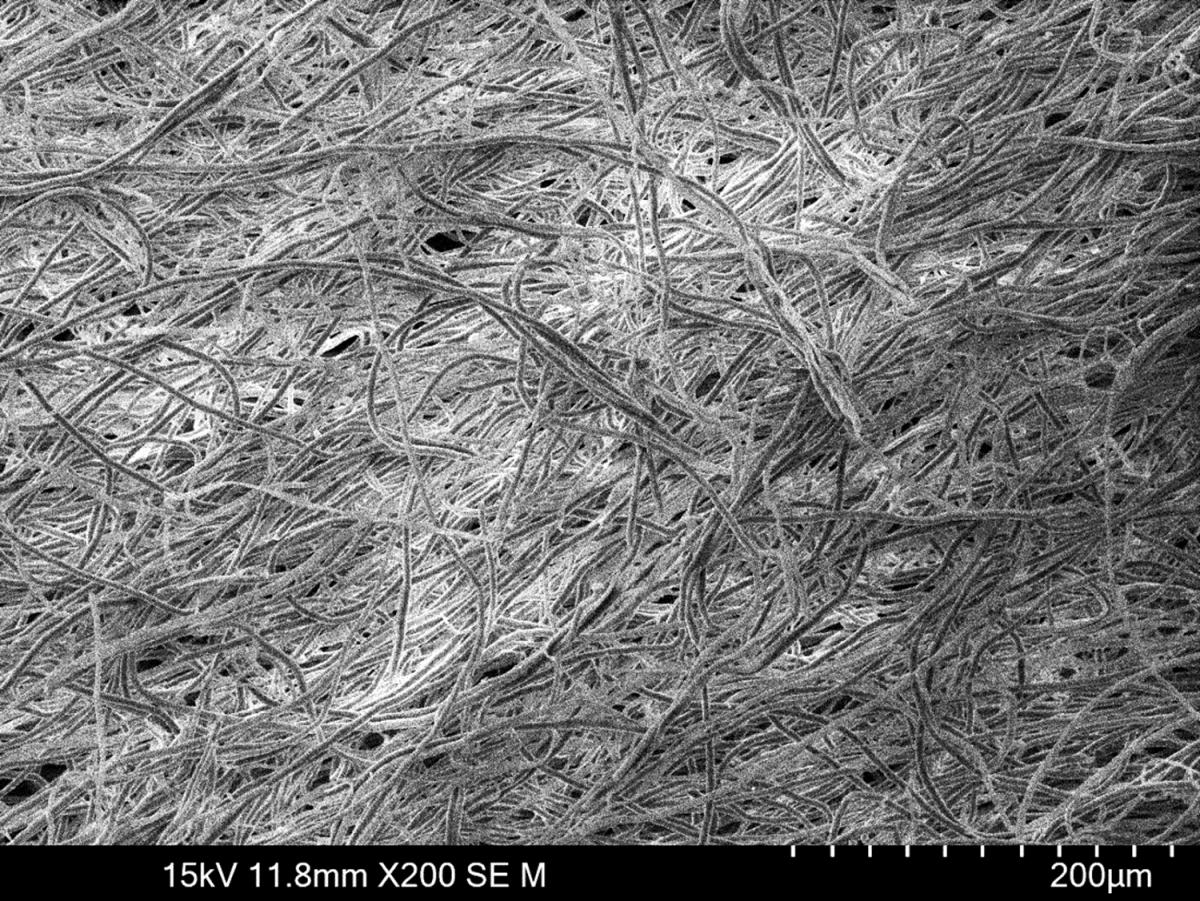
The absorbency is not a coating, it is the structure itself. The trama is a mat of densely packed hyphae shot through with open pores, giving water somewhere to go. When a wet fly touches an amadou patch, capillary action pulls moisture off the hackles in seconds without crushing them. That same mechanism is why a hat or bag feels dry against skin: sweat moves into the fiber and evaporates out.
The flip side: the material has no water-repellent finish and absorbs what it touches, including hand oil, which is why the care rules below matter more than they would on a synthetic.
The following image is the first SEM microscopic image of an amadou trama published ever, which emphasize the dense hyphae structure, and nothing else in the stretched amadou sheet.
An Honest Word on Durability
This is a natural material, so it will not survive being dragged across gravel or left soaking in a puddle. With basic care, it handles daily wear, seasonal rain, and constant handling. Anglers have trusted amadou for drying artificial flies for generations because it pulls water out of delicate hackles in seconds without crushing them.
Over time the surface nap flattens slightly, the tone deepens, and the fiber softens, the aging pattern owners tend to prefer, like a good leather patina. Watch instead for structural damage: a seam pulling apart, a hard spot that never softened, or a patch that stops absorbing because it is saturated with hand oil.
Care rules that actually protect performance
Caring for amadou accessories takes less effort than caring for leather, but the rules are stricter. Do not wash them. Do not soak them. Do not wring them out. If a hat or bag gets damp from rain or sweat, let it air dry naturally at room temperature, away from direct heat. The fiber releases moisture on its own, which is the same property that makes it comfortable to wear.
A few habits keep a piece in good shape for years:
- Brush off loose dust with a soft, dry cloth
- Blot spills immediately rather than rubbing them in
- Store flat or lightly stuffed so the shape holds
- Keep it away from radiators, hair dryers, and direct sun
- For the small screen and lens sheets, wipe gently and let them rest
That last point matters more than people expect. The same absorbency that dries a wet fly or lifts a fingerprint also means the material will happily drink whatever it touches first, including oil from your hands. Keep it clean and it stays effective.
Restoring a patch or Hat after heavy use
If a fly patch has gone slick and stopped grabbing water, or a hat has picked up a shine from hand oil, the fix is gentle and does not require replacing the piece.
For a saturated patch, work mild, unscented soap into the surface with your fingertips, rinse briefly under cool running water, do not soak it, press flat between two clean cloths, then air dry away from heat. The pores reopen as the oil leaves and absorbency returns. For a shiny hat or bag, a light brushing with a soft-bristled brush along the nap restores the velvet surface.
How it compares to synthetic drying agents
Anglers often ask whether a natural amadou patch beats a synthetic desiccant or microfiber towel. They solve the problem differently: a desiccant pulls moisture from the air but does not wick water off a fly, and a microfiber towel blots but can crush delicate hackles and needs repeated wringing. Amadou pulls water directly off the fly through capillary action, without pressure, until the fiber itself is saturated.
The trade-off is capacity: a small patch holds limited water before it needs to dry out, so serious anglers rotate a patch or pair it with a towel for the bulk of the water and use the amadou for the final, delicate pass.
Ethical harvesting and the artisans Behind Amadou
Ethical harvesting comes down to how the fungus is collected, how much is left behind, and who does the work. Fomes fomentarius fruiting bodies can be gathered from living and fallen trees without killing the host. A responsible harvest takes mature conks, leaves younger growth to spore and spread, and never strips a tree bare.
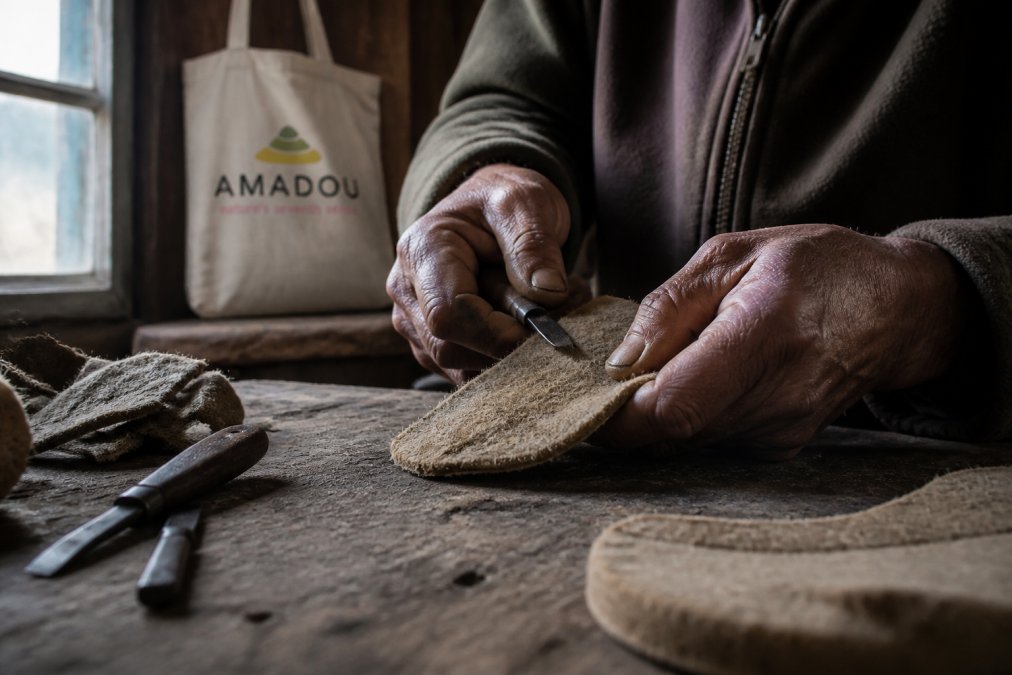
Artisan shaping amadou for fomes fomentarius accessories on a rustic wooden workbench in a Corund workshop.
For proof of origin, ask a seller directly where a piece is made and who made it.
Choosing your Fomes Fomentarius accessory: a buying guide
Choosing the right piece starts with one question: what will you actually use it for? The formats are not interchangeable, and matching the accessory to your routine keeps it in rotation instead of in a drawer.
If you want... |
Choose |
Price |
Best For |
|---|---|---|---|
Sun and rain coverage |
starting from $195.00 |
Hiking, travel, garden |
|
Everyday wear |
Docker cap |
starting from $199.00 |
Commuting, casual outfits |
A dressier look |
Flat cap |
starting from $215.00 |
Smart-casual, gifts |
A carry-all |
Patchwork bag |
starting from $169.00 |
Daily errands, markets |
A lightweight tote |
Legacy shoulder bag |
starting from $135.00 |
Travel, minimal carry |
A small gift |
Bracelet |
$25.00 |
Stocking fillers, first buy |
A fly fishing tool |
Fly drying patch |
$16.00 |
Angling, tackle box |
Clean optics |
Lens and screen cleaner |
$16.00 |
Phones, cameras, glasses |
Start with the smaller pieces if you are new to the material. A bracelet or a screen cleaner costs little and lets you feel the texture before committing to a hat or bag. From there, the hat is the piece most owners reach for daily.

What separates a well-made piece from a cheap one
With amadou, quality is decided long before the finished object reaches a shelf. Here is what to inspect, in order of how much it tells you.
The trama, not the trim. The usable fiber is the inner layer, and its quality depends on how evenly it was cut, stretched and how patiently it was softened. A well-prepared sheet has a uniform, suede-like nap with no hard patches. Run a fingertip across it: it should feel consistent edge to edge. Hard spots are trama that was not fully relaxed or may containg woody layers and will not soften with use. The artisans focus to use the softest patches on the parts of the hat where softness is needed.
The stitching and seams. Because a hat or bag can consume multiple sheets, seams are where craftsmanship shows. Look for tight, even stitching with no puckering or gaps. On a hat, check the inner band where crown meets brim, the highest-stress seam and the first place a rushed build fails.
The shape and structure. Amadou is soft, but a good piece holds a deliberate form. A hat brim should sit level and spring back when flexed, not droop or crease permanently. A bag should keep its silhouette when empty.
The weight-to-size ratio. The fiber is genuinely light, so an unusually heavy piece is a warning sign, usually excess backing, glue, or a synthetic liner compensating for thin trama. Ask what the piece is made of beyond the fungus.
The seller's answers. A real workshop can tell you where the fungus was harvested, how the trama was processed, and who assembled the piece. If a listing only says "mushroom leather" and cannot name the fiber or maker, treat it as a reseller at best.
Match the format to the job
A few pairings are worth spelling out. For fly fishing, the small and thick drying patch is the workhorse, it lives in a tackle box, pulls water from hackles in seconds, and costs little enough to keep a spare. For travel, the shoulder bag and big rim hat earn their space because both compress down and recover their shape. For a first purchase or gift, the bracelet and screen cleaner are low-risk entry points.
The spread from a $16 patch to a $300 flat cap reflects that a hat can consume multiple hand-stitched sheets, while a patch is a single small offcut.
Conclusion
Any natural material asks for a little attention in return for a lot of character. Amadou builds its collection around that trade: hand-shaped hats, earthy bags, and tactile bracelets made from Fomes fomentarius trama, each weightless, moisture-wicking, and free of chemicals. If you want a vegan alternative to leather that breathes, ages well, and carries a real heritage story, browse the collection and pick the piece that fits how you move through the world.
USDA Forest Service guide to polypore fungi and wood-decay species
Cornell University mycology resources on fungal fiber structure
U.S. Fish and Wildlife Service guidance on ethical wild harvesting
Frequently Asked Questions
What are the benefits of Fomes fomentarius accessories?
Fomes fomentarius accessories offer natural moisture-wicking, lightweight comfort, and a velvety texture similar to suede. They are 100% vegan, chemical-free, and biodegradable. The material is hypoallergenic and develops unique character with age. Unlike synthetic leathers, amadou is breathable and temperature-adapting, keeping you cool in heat and cozy in chill.
How durable are mushroom-based accessories compared to real leather?
Amadou accessories are stretchable and durable, though they require different care than animal leather. They resist moisture and maintain structure with proper handling. Avoid washing; instead, air dry if damp. With mindful use, they age gracefully, developing a patina. They are not meant for heavy abrasion but excel in everyday wear and outdoor conditions.
How do I care for my amadou accessories?
Do not wash amadou accessories. If they get damp, let them air dry naturally away from direct heat. For screen cleaners or fly patches, rinse occasionally with water and air dry. Avoid prolonged soaking. Store in a breathable bag. The material is self-cleaning to a degree, but gentle handling preserves its softness and absorbency.
Is Fomes fomentarius sustainable and eco-friendly?
Yes. Fomes fomentarius is a wood-decay fungus harvested from wild forests. Amadou production uses no chemicals, chrome, or plastics. The material is biodegradable and vegan. Harvesting is done ethically, preserving the tradition and the forest ecosystem. Choosing amadou supports artisanal craft and reduces reliance on synthetic or animal-derived materials.